Comments

'And finally, not everyone’s being doing topical. In fact, here’s the rather lovely 6 Oxgangs Avenue devoted to the history of the development of the area, this week highlighting how the block of flats came into being. Could have been prompted by Who do you think you are? Or just a timely reminder that not everything worth blogging about is in the here and now.'

Kate Higgins, Scottish Roundup 26/08/2012


Tuesday, 9 October 2012

The Penny Didn't Drop

Did anyone in the The Stair do hobbies back in the 1960s?


Initially I couldn't recall anyone doing so then remembered Douglas Blades (6/6 Oxgangs Avenue) collected railway ephemera.


For a while I did a little bit of stamp collecting - partly intrigued by the Stamps on Approval adverts in The Hornet and The Victor - partly because my Aunt Heather collected stamps and they looked fascinating - and also, because it helped me achieve the only Cubs' badge that I ever got, my Collectors' Badge.


I of course was taken in by the stamps advert not realising what the term (small print) On Approval meant and instead believing the stamps were free, along with a magnifying glass, etc.


Anyway despite reminder letters I never sent the pack or the money back to the company.


Other hobbies were short lived - collecting a few football team pennants; or the little cloth or vinyl badges of towns that one had visited (not many) - the Dublin badge came from my grandparents but I did visit Pitlochry with them; these could be sown onto your anorak; then there were football programmes but again this hobby was relatively short lived.

However, the one hobby if it could be called such is that every time I came across a Victorian coin I kept hold of it.

It was mainly pennies - I had a few half pennies and possibly a single Victorian shilling. However, over a couple of years I amassed an immense collection of Victorian pennies - given that there were 240 to the pound I must have accumulated over one hundred coins.


They mainly featured the old Victoria but I also had a fair number of the young Victoria too.


Clearly the Bank of England wanted to get its money worth because some of the old copper coins were so very worn that you couldn't make out much of the design never mind the date - indeed some of them must have been in common circulation for over 150 years - never mind walls but if pennies could have talked what stories they could have told - whose hands had these coins passed through over the centuries and decades - Dickens; Stevenson; Churchill; The Beatles...?

Although often I might be hard up or in need of money I remained steadfast and kept my collection intact for several years.

And then for no particular reason on one lazy summer afternoon during the school holidays I decided my collecting days had come to an end.


I ventured up to Ewart's newsagents at Oxgangs Broadway.


In some trepidation I ordered lots and lots of sweets and comics keeping the coins hidden from view.


When the counter was littered with a feast of delights (the assistant must have begun to wonder) I then produced the coup de grace and proceeded to pay with Victorian pennies and half-pennies -around 100 coins!

The poor shop assistant didn't know what had hit her!


Monday, 8 October 2012

Victor?

Victor?

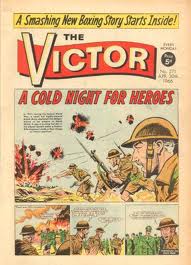
The comics of the 1960s were sensationally good, both in the quality of the stories and the artwork too.

The Victor was an important comic for my brother Iain Hoffmann and me but I don't think any other boys in The Stair read it.

It was a regular purchase for us. The comic ran from 1961 to 1992, probably the longest run of the comics from that era. Indeed I know that Iain was still getting his copy when he worked at Ferranti's.

A sad demise; if it were still on the go today, we'd buy it!


There were key characters who featured regularly - Braddock VC ,a surly, but deadly Second World War pilot. Initially I didn't get in to him at all, but in later years I began to appreciate him; but both Morgyn the Mighty and The Tough of the Track had an important influence on me.


Clearly I was buying the comic regularly when Iain was seven years old and I was nine, because a Morgyn the Mighty story of the world's strongest men being relocated to a remote island to fight it out to the death remained with me making a deep impression. Today I've a complete run of that story
.

DC Thomson the publisher ran a good series (175 issues) called Classics From The Comics from March 1996 until October 2010 which reprinted many of the stories from its files.

Because I was keen for Will and Tom to experience some of the pleasures that we at The Stair had enjoyed I took out a subscription for the boys. Name-dropping - if you look carefully at Issue 149 you can see above that the Hoffmanns took an active part.

Tom Hoffmann, July 2010


Tom Hoffmann, April 2009

Tom was the biggest fan in the house and read every copy from cover to cover, several times over.

Indeed, when I asked him for the copy featuring the Hoffmanns he went straight to it - it would have taken me hours to find.

If he were ever to appear on Junior Mastermind, his specialist subject would have to be Oor Wullie, The Broons and Classics From The Comics - a bit like Oor Wullie on his bucket, he'd spend hours on the lavatory reading them.


There were some compensations from the boys reading such cartoon strips. Back in 2007 Alison and I attended the Dingwall Academy Prize-Giving and were pleasantly surprised to see that Will had won the School Essay Prize (£50) which was reprinted in the programme. In true cartoon fashion he treated five of his mates to a 'slap up feed' in Inverness.


Alf Tupper's athletic adventures were my favourite strip in the comic.

Alf was a working class man living under a railway bridge. He lived on fish n chips and took on the toffs at big athletics meetings. I loved the stories and the art work was super - the imagery of the athletics meetings greatly appealed. In a later blog I'll write in more detail on Alf Tupper and Wilson the Wonder Athlete (The Hornet) and their great influence on me.

Victor?

No, loser.

It was a very sad day when The Victor and other such comics hit the dust.

I've occasionally thought about approaching the company to buy the rights to the comic with a view to reprinting them weekly - I thought there might be a market for both today's dads and grand-dads of my generation and their sons and indeed grandsons.

Sunday, 7 October 2012

'The Wee Blue Devil' and The Sunday Express

Grandfather, Willie Robertson, Stobo 1972 (Photograph, Heather Robertson)


My grandfather was originally from Glasgow and supported Glasgow Rangers FC. He was a great story-teller-goodness knows what he'd say about their present plight! 

Alan Morton aka 'The Wee Blue Devil'.


Along with The Sunday Post he also bought The Sunday Express. He must have encouraged me to write to the sports editor of The Sunday Express who took time out of his busy schedule to write back to me with this rather charming letter. I endorse the philosophy too.


Saturday, 6 October 2012

Hearts or Hibs?

Did you support Hearts or Hibs?

Attending football matches at Tynecastle or Easter Road was a right of passage for many boys in Oxgangs.

Ken Hoffmann was a rugby man. I only ever remember going to a single match with him-it was Hibs v Dunfermline-how did that happen? Did he have free tickets? Was he trying to bond with his son? Anyway, I recall him getting into an argument with a Hibbie when Roy Barrie the combustible Dunfermline player got sent off-I actually sided with Ken on this occasion, because there was a sense of injustice about the decision. The other thing I admire today, from a distance, was that Ken subscribed to the philosophy that it was better to play the game than to spectate.


Within The Stair I think John Duffy from 6/8 attended games with his dad; he was a Celtic supporter. Boo-Boo Hanlon must have been too-see below! Colin Hanlon was a Hearts man and a regular at Tynecastle in later years. Alan Hanlon was perhaps too young back then, whilst for all his enthusiasm for football, I can't recall if Michael went along or not. Michael, Boo-Boo, Colin or Alan-if you're reading the blog, please let us know!

Boo-Boo Hanlon (Photograph, Peter Hoffmann)

Douglas Blades and Gavin Swanson were completely uninterested in footie-indeed they may never have ever kicked a ball in their lives. Although Iain played a wee bit he only ever went to a match on rare occasions-he was most definitely a Hearts man-I seem to recall us going to see Hearts v Brechin City of all matches on Saturday, 27th January, 1968!

For a season or two I attended Hibs matches in the company of the Allans from 4/7 Oxgangs Avenue-this was with Andy and Gavin Allan and one or two of their pals who attended the Catholic secondary school.


It was exciting stuff-good crowds; often it was sunny; the green and white programmes reflecting the strip; and some good players on the pitch-Bobby Duncan; Pat Stanton; Peter Cormack; Peter Marinello-there was a real buzz about such outings.

Peter Marinello and Peter Cormack

Today I'm not a supporter, but when Hearts met Hibs in the Scottish Cup Final earlier this year in May, my heart was very much with the Hearts-my instinct tells me that if I should follow any team then it is Hearts. Perversely, for a while I also used to attend Raith Rovers matches at Kirkcaldy with a slightly older lad from Oxgangs Crescent-it was good fun getting the train from Haymarket to their ground which still boasted an old siren from the War.

Rangers FC 1967-This  Picture Hung On The Bedroom Wall In A Frame For Years 

So was it Hearts or Hibs or indeed Raith Rovers? Well, ironically, at that time I also 'followed' Rangers because I was so close to my grandfather, but never attended one of their matches back then-indeed Ken Hoffmann stipulated that we weren't allowed to go along to any games involving The Old Firm because of potential trouble-probably sound advice.


Postscript; My local team today, Ross County, were unbeaten over 40 league matches until a week or so ago-Come Away The County!


Friday, 5 October 2012

Good Time?

Good time?


In the summer of 1971 that was a question often on the lips of the younger residents of The Stair, as well as kids from numbers 2,4 and 8 Oxgangs Avenue and also for others from Oxgangs Street. 

In June, 1971, Paul Forbes, Iain Hoffmann and I visited a pawnbroker in the Grassmarket with the express purpose of buying a stopwatch. It cost me a fiver (£5). I had decided that my latest wheeze for the summer would be to organise athletics over the school holidays. Little did I know that it would attract over thirty kids as active participants. Today the relatively useless Active Schools Coordinators scheme pay officers £30k a year for doing less work with less success! Supplementing the stopwatch, was a measuring tape that I had managed to borrow from Bill Walker at Meadowbank Sports Centre and a little notebook and pen.


Paul Forbes and Peter Hoffmann at Meadowbank Sports Centre asking Bill  Walker for a wee loan of the measuring tape!
Within the notebook there was a section for each participant recording their best times and their best jumps. As Ruth Blades (Kaye) mentioned in a previous comment the events consisted of: Fence (Hoffmann garden) to Lampost (outside No 8 Oxgangs Avenue)-a pure short sprint: Bus Stop (outside No 2 Oxgangs Avenue) to Lampost (outside No 8 Oxgangs Avenue)-the classic sprint distance; Once Round The Two Blocks-a lap (or loop) of Nos 6 and 8 Oxgangs Avenue-three short bursts and two longer bursts with four left (right angles) turns; and finally the classic distance of Once Round The Four Blocks-The Stair's equivalent of one lap of an athletics track. We were quite happy to accommodate other requests too e.g. twice or three times Round The Four Blocks.

Some of the Oxgangs Mini Olympics competitors.
Esther Blades; Iain Hoffmann; Ali Douglas; Ruth Blades
Alison Blades; Boo-Boo Hanlon; and Eileen Hogg
Paul Forbes; Peter Hoffmann; and Iain Hoffmann 'jumping for joy!'
We also used to put on long jump and triple jump competitions too, which were held across from The Stair on the other side of Oxgangs Avenue on a grass strip beside the bus stop. These events could easily last for over an hour and more; they must have been quite entertaining for those queuing for a bus!

Triple Jump Venue Oxgangs Avenue

To help make everyone feel involved a relatively short distance would be marked out. I knew everyone could make the distance-even those as young as say Esther Blades. Each participant would have three attempts at each set distance to be able to advance to the next round and distance. The distances would be incrementally increased, but only gradually-this meant that everyone was involved for a good length of time, because each person had to complete the challenge. For those who were younger it would take a big effort to progress; if you were older or quite athletic one might show off or fool around in the early rounds and it served as a good warm-up.

As the distance became more challenging everyone was very supportive encouraging their pals to make a big effort to try to reach the distance and progress to the next round-if a younger child made it, a big cheer went up-if one didn't make the mark, there was commiseration that you'd make it next time!

Willie Taylor; Derek Ramage; Mark Robertson; John Duffy; and Stephen Westbrook

Because everyone was so involved from the start, even once you were eliminated, everyone tended to stay on to see how the event progressed; to see who would eventually jump the furthest; and how far each person actually leaped. Also if you were knocked out you might become a judge or set the marker distances. And, although it was a competition, ultimately everyone, both won and lost-this was because you would usually get a personal best, but eventually we all failed at some stage to reach the marker.

Similarly, by running and timing each of the set distances, these were mainly done individually, so one was competing against one's self trying to improve one's personal best; if you were competitive, you could compare your times against your peers.

I kept the notebook for decades-I think it was stored in my grandmother's attic, until she died, when it became lost. It may still be amongst my own papers, but I don't think so. I was always tempted to take Will and Tom out to Oxgangs Avenue to see how they might compare to our generation's times. They would certainly have been game.

Will Leading Tom, National Gallery of Modern Art, Edinburgh
(Peter Hoffmann, 2009)
Until relatively recently when we visited the National Gallery of Modern Art in Edinburgh, I always had to time them on a lap of  the Charles Jencks Garden. Will started to outpace 'the old man' two years ago (but only up to 200 metres!)-it's taken Tom (16) until this year-I think!

Will (1st) (Second right, black T shirt) age 16 finally beats  The Old Man (3rd)
Final Open 100 Yards Strathconon Highland Games 2010

Thursday, 4 October 2012

The Broadway


When you are young you accept the world as it is. And that it must always have been thus.

From a young age I used to go up the hill (Oxgangs Street) regularly to the (Oxgangs) Broadway. 

Initially, I would be sent for messages and when older it would also be of my own volition too. 

Probably this was from the age of only three or four.   And whilst I enjoyed running messages, there was always the worry of crossing the path of an older boy with a fierce reputation for confrontation. Although I had some very occasional run-ins with him, I somehow managed to either talk myself out of trouble with him; alternatively I could have taken to my heels, although he was a quick runner. But more often I boxed cleverly and simply took a detour via Oxgangs Row therefore adopting a pragmatic non-confrontational approach; it was however an ongoing concern and I know that many friends of mine suffered quite badly.

Growing up in the area I never really considered that the shops at Oxgangs Broadway had not always existed, whereas they were built around 1953/54. And of course behind each and every business venture, there was an individual and human story-a tale of individuals seeing an entrepreneurial opportunity and actively taking the risk of following the dream.-a dream of making it economically-working for one self and aiming to provide for one's family to lead a good and satisfying life.


Oxgangs Broadway In The Winter

A collection of the individual stories of these early pioneers from sixty years ago would make for interesting reading today-their hopes and aspirations; successes and failures; ups and downs; joys and worries; colourful customers, colourful stories and lessons learned. Was it a success or was it a failure? Did it provide a good income or was it always a struggle? How did it affect their health? What happened if they were ill? Was the business seasonal? How above board was it? Were there unusual or unorthodox transactions and business arrangements? Did the stock fall off the back of a lorry! Did some customers get tick? Did the early aspiration meet the realisation? Did it become a conveyor belt that one couldn't get off? If they could go back in time would they have done it all again?

All these stories, now sadly gone.

As a customer I only saw the shops as being retail institutions, for our convenience, not realising there was a human story behind each and every one.

I assume that when the public housing schemes were first muted, agreed, planned for and thereafter designed and developed after the war, that Edinburgh Council must have taken cognisance of local needs and included these small retail shop units for rental. Did they deploy a prescriptive and restrictive policy whereby they had a shopping list of the range of businesses they wanted e.g. one post office; one chemist; a dry-salter and so on or was it just a laissez-faire approach?

Probably for most of the individuals, it would have been their first venture as a self employed businessman. I suspect that for some of them they had perhaps worked in the particular trade, but never before been the owner of the business. Now here was a once in a lifetime opportunity to go it alone-what excitement-what a worry!

Similar to tenants becoming home owners under Mrs Thatcher's government I wonder if in later years and decades they thereafter had the opportunity to purchase the shop units? I expect so.

Oxgangs Crescent Shopping Precinct Shortly Before Demolishment

The shops at Oxgangs Crescent (sadly, now demolished) were similar to those at Oxgangs Broadway, except there were fewer of them. The shops at Oxgangs Broadway remain today, but are of course all different. There are some similar types of shops to the past-a newsagent, a chemist, a post office, a baker's, but also a betting shop and three hairdressers; there is a convenience store-family owned, long established which has picked up some awards. 


Oxgangs Broadway (Photograph Mark Travis)

The Oxgangs Broadway design is a rather dinky and clever lay out, which when seen from above is shaped like a cockit hat-an interesting triangular shape with a road bordering the three sides-similar to the Cockit Hat at the Redford Road/Oxgangs Road North junction. On the north side there are some flats located above the shops, which unusually take up two floors i.e. levels two and three. The flats are most handily located if you run out of bread, milk or sugar or want to nip out for an early morning roll or newspaper. 

The shops are set down below ground level in a small self-contained dip of ground; there are approximately a dozen shops. These shops are evenly distributed and laid out opposite each other. The area between the shops serves as an interesting social area where during the day, local neighbours could catch up with one another’s news. 

Back in the 1960s the shops were fairly small. However, there was a general store which was larger than the others-perhaps it was a double unit? Behind the shops and up above were some further units, but these were mainly used by the shop-keepers down below as storage units. Today, these units are all in use including a large Corals bookies! It's not surprising, because these shop units are south facing and one can park directly outside; however they are set away from the main body of the kirk.

In the 1960s there were two important exceptions to the storage units-Ben Mackenzie, the hairdresser and Rissi’s fish and chip shop-these two businesses occupied either corner site. 

An earlier blog was called Cellophane, Airfix and Ben Mackenzie (Oxgangs Broadway, Shop No 1)-after all how could Ben be anything other than number one!

I intend to do short blogs in future on each of the 1960s shops, so if you have any memories, please let me know.

Wednesday, 3 October 2012

6/5 The Smiths-Eric and Mary

6/5 The Smiths flat at The Stair (Photograph, Peter Hoffmann 2012)
There were twenty four children living at The Stair-a remarkable number, more or less a school class size. There was only one household without children, and that was 6/5, The Smiths. I wonder whether that was a conscious decision on the part of Eric and Mary?

Eric would have made a good father. He was a very pleasant and gentle man. I always picture him wearing a white shirt, open neck and grey trousers. Of an evening he often sat at his sitting room window watching the local boys play football in the back field. He was also the only local man who ever occasionally ventured out to join in and play football with the kids-I quite admired him for doing that. It was only for a short time and as mentioned I recall him pulling a hamstring; that was perhaps his swan-song. When Eric sat at his window watching the boys play, did he reflect upon or regret not having children himself?

His wife, Mary, was quite a fragile lady and I think was unfortunately troubled by her 'nerves'. She was slim and had dark hair-I may be wrong but I seem to recall her having dark shadows under her eyes, possibly because she didn't sleep well. Someone said to me that at one time she didn't sleep for a whole year-clearly she mustn't have been related to Rip Van Winkle. If that was true it must have been hellish for both of them.

They were a quiet couple,and in many ways, were perhaps unsuited to living in The Stair with seven lively families who had children. For a while they had a dog who was a bit temperamental-as Douglas Blades rushed down the stairs shouting 'Neeep!' it barked furiously, probably to Dougie's delight!

We didn't see a lot of Mary Smith as she seemed to stay indoors for much of the time. I think most of the responsibilities fell upon Eric, whether it was buying the messages or other tasks-I know Anne Hoffmann felt quite sympathetic toward him. He was employed in basic jobs, at one time he may have been a postman. I think he was probably pleased when he got a secure job at Marks and Spencer as an storeman. He was a modest sort of a chap. I think they were quite close to Hilda and Charlie Hanlon and on good terms with Helen Blades. I don't recall them being religious at all.

They seemed to live a quiet life and Eric's raison d'etre was to look after Mary as best as he could.

Tuesday, 2 October 2012

NB ! No Pedlars, Hawkers or Salesmen!

An advertising link has mysteriously appeared on today's blog-you might be better skipping over it!

Balloon or A Balloon?

Balloon or A Balloon?


Another of the extra-ordinary characters who visited The Stair each week was the rag n bone man.


He would ring a bell and announce his presence. Pavlov in action yet again-as soon as I heard his cries I rushed into the bedroom pushing Anne and Iain out of the way to grab the nearest item of clothing. As mentioned by Liz Blades, 6/6 The Stair, yes sometimes it was my beautiful little blue coat so lovingly made by my Nana (Grandma Jo) or the leather jacket brought back to me from New York by Ken Hoffmann that was handed over in exchange for a balloon.


The irresistible  magnetic draw for me was the large, old, battered suitcase full of colourful toys, trinkets, puzzles, jokes and yes, balloons which lay inside the open suitcase in the back of his van. Aladdin's Cave was not too strong a description because in grey and white Oxgangs this was indeed colour on a small canvas. One couldn't wait to get to the front of the queue and see and be instantly transported to this wonderful world that lay inside the rag n bone man's magical suitcase-a veritable box of delights!


Balloon or a balloon? I'm sure John Masefield would have understood!


Postscript: As mentioned in yesterday's comments exchange Mrs Anne Hoffmann will give the real version on the rag 'n bone man. And, as tantalisingly alluded too, more on A Man And A Suitcase in a future blog!

Monday, 1 October 2012

Hillend and 'Jean Claude-Killy'

How many primary schools offered skiing as part of their curriculum back in the 1960s? Eton, Loretto, Watsons? Well, actually, I was thinking of Hunters Tryst Primary School.

Hillend Ski Slope in the shadow of the Pentland Hills

In an earlier comment, Ruth Blades (Kaye) remembered  Hillend Ski Slope. For the likes of David Lines, Bryan Rennie, Norman Stewart and me we were very lucky-in our last year at school (P7) we had the chance of attending skiing lessons. We were incredibly excited. This would be the first occasion that a class from the school had been offered this opportunity. Lothian Regional Council had developed an artificial ski slope-the longest in Europe-on the north facing side of the Pentland Hills.

So, each Friday morning for a term or so, we were transported by bus the mile or two up the road to Hillend from Hunters Tryst School. It was a lovely break from school. Unfortunately, I never took to it at all. Wearing heavy and uncomfortable boots it was a bit of a long trudge up the road from the cabin at the Biggar Road entrance to the artificial slope; the weather was poor and we often ended up soaked; and I could never quite master the skis-they felt awkward and cumbersome. Also, I didn't particularly like the Austrian instructor called Hans. On top of that I never had the 'bottle' for going down the slope from the top-even back then when it was at a more intermediate level. Apart from that, it was fine-boy, what a wimp!

A nice surprise was that someone from The Stair who did take to skiing was Iain Hoffmann. Up until then Iain hadn't previously excelled at sport, but did have 'the bottle' to go down from the top-a bit like his diving where, like 'the old boy' (Ken Hoffmann) he was always happy to throw himself from great heights into water-oops, shouldn't have mentioned Ken Hoffmann-I feel another Ken Hoffmann Being Different story coming on!

Iain ('Jean-Claude Killy') Hoffmann circa 1969
(Photograph, Glasgow Herald)

Iain went on to represent the school in a skiing competition-here's a lovely photograph of him (above) that appeared in the Glasgow Herald newspaper at the time-I don't know how the family became aware of the photograph-perhaps someone got the newspaper at my Aunt Heather's office at work? Anyway, it's captured a lovely moment in time.

Most unfortunately, Iain was diagnosed with multiple sclerosis last week-it would seem he's had the condition for years, but it's taken until now to identify it as the slow progressing type-he's being very positive about it-hope in a very small way the photie gives you a lift Unc.

And who would have thought it-a school located in Oxgangs  offering skiing lessons!