Comments

'And finally, not everyone’s being doing topical. In fact, here’s the rather lovely 6 Oxgangs Avenue devoted to the history of the development of the area, this week highlighting how the block of flats came into being. Could have been prompted by Who do you think you are? Or just a timely reminder that not everything worth blogging about is in the here and now.'

Kate Higgins, Scottish Roundup 26/08/2012


Showing posts with label Charlie Hanlon. Show all posts

Monday, 17 November 2014

The Birth of The Stair and A Christmas Carol

Birth: 'the coming into existence of something'.


In the bleak mid-winter, Dickens' Christmas stories give the reader images of hope and light; warmth and joy; as well as transformation and resurrection. However, the light is tempered by the darkness and cold too which makes it even more life enhancing. 

The hope comes from spring, surely following winter and the renewal of life as Scrooge is restored to the good values of his boyhood and youth. 

Six decades ago in the deep mid-winter of 1958, the Hanlon family moved into the newly built Edinburgh Corporation flats at 6 Oxgangs Avenue to take up residence at ‘The Stair’; Charlie and Hilda were full of hope at the beginning of the exciting adventure ahead and novelty of bringing up their family in a new home.

Like the other young families at ‘The Stair’ they had their dreams and aspirations of the good life and raising their children as well as they could, with all the fun, joys and worries inherent.

At this time, only Michael, the eldest brother had been born; he would only have been around one year old; Brian, Colin and Alan would come along in the following years.

When the family took up their tenancy at 6/7, like the other seven families in residence at ‘The Stair’, they were issued with a rent book. It records their rent as being eighteen shillings a week.


Most remarkably, Hilda, the last remaining original member at ‘The Stair’, still has the family's first rent book. It records their date of entry as 15th December, 1958.


In a way the document records the birth of ‘The Stair’, when one of the original inhabitants first took up residence there and is perhaps a unique document of its type. 


Brian speaks humorously about the family's first experience. Hilda recalled the Hoffmann family had already moved in downstairs to 6/2 slightly earlier. The coal-man was delivering coal to our family - Ken and Anne Hoffmann, the author (Peter aged two) and my brother, Iain (aged only a month).

Hilda wanted to buy some coal in too, to heat their new home. However, the coal merchant turned down her request as she lived on the top floor and he mustn't have fancied walking up another three flights of stairs. Given it was mid-winter and Michael, the eldest brother was still only a baby, the stone-hearted coal-man clearly wasn't full of the Christmas spirit.


He reminds me of Ebenezer Scrooge to Bob Cratchit, that '...there will be no coal burned in this office today...'  

Hilda must have found a way forward, not only to heat their new top flat home with its fantastic views to the hills and the sea, as well as the prominent Edinburgh Castle, as she and Charlie went on to successfully raise their four boys in a happy household, throughout the decades of the 1960s and 1970s. 

'Edinburgh in Snow' William Crozier


Spring and indeed summer followed winter. 

Wednesday, 3 October 2012

6/5 The Smiths-Eric and Mary

6/5 The Smiths flat at The Stair (Photograph, Peter Hoffmann 2012)
There were twenty four children living at The Stair-a remarkable number, more or less a school class size. There was only one household without children, and that was 6/5, The Smiths. I wonder whether that was a conscious decision on the part of Eric and Mary?

Eric would have made a good father. He was a very pleasant and gentle man. I always picture him wearing a white shirt, open neck and grey trousers. Of an evening he often sat at his sitting room window watching the local boys play football in the back field. He was also the only local man who ever occasionally ventured out to join in and play football with the kids-I quite admired him for doing that. It was only for a short time and as mentioned I recall him pulling a hamstring; that was perhaps his swan-song. When Eric sat at his window watching the boys play, did he reflect upon or regret not having children himself?

His wife, Mary, was quite a fragile lady and I think was unfortunately troubled by her 'nerves'. She was slim and had dark hair-I may be wrong but I seem to recall her having dark shadows under her eyes, possibly because she didn't sleep well. Someone said to me that at one time she didn't sleep for a whole year-clearly she mustn't have been related to Rip Van Winkle. If that was true it must have been hellish for both of them.

They were a quiet couple,and in many ways, were perhaps unsuited to living in The Stair with seven lively families who had children. For a while they had a dog who was a bit temperamental-as Douglas Blades rushed down the stairs shouting 'Neeep!' it barked furiously, probably to Dougie's delight!

We didn't see a lot of Mary Smith as she seemed to stay indoors for much of the time. I think most of the responsibilities fell upon Eric, whether it was buying the messages or other tasks-I know Anne Hoffmann felt quite sympathetic toward him. He was employed in basic jobs, at one time he may have been a postman. I think he was probably pleased when he got a secure job at Marks and Spencer as an storeman. He was a modest sort of a chap. I think they were quite close to Hilda and Charlie Hanlon and on good terms with Helen Blades. I don't recall them being religious at all.

They seemed to live a quiet life and Eric's raison d'etre was to look after Mary as best as he could.

Sunday, 26 August 2012

Ken Hoffmann Being Different, No 2


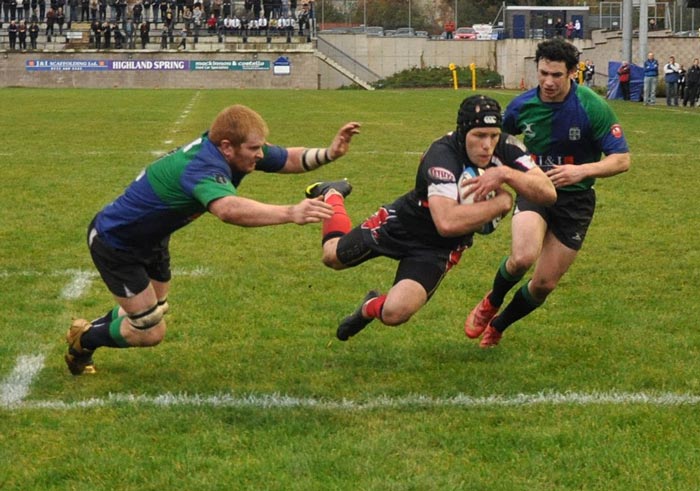
Another example of just how different my father, Ken Hoffmann, was from the rest of the fathers in the neighbourhood was that he played cricket all summer and rugby all winter. I suspect he must have been the only man in Oxgangs who did this. He played full back for Boroughmuir at rugby and cricket, for of all clubs, the Grange, perhaps the poshest club in town? Sometimes he also played cricket for Boroughmuir too-perhaps that was when he couldn't afford the the Grange subscription fees? More remarkably he was one of the oldest fathers in the area-when I was ten he was forty. He carried on playing both sports into his mid-forties when his heavy smoking and heavy drinking caught up with him.

A match being played at the Grange Cricket Ground, Stockbridge, Edinburgh
Football was clearly the working class sport, but fathers had long since given up the game. Looking back, such pastimes were given up to youth at a very young age indeed; many of the local fathers must have been really quite young compared to fathers today. Nowadays, the value of sport and exercise are promulgated and encouraged and it’s common practice see fifty and sixty year olds playing sport. Indeed, such a large part of the NHS budget is spent on early knee and hip replacements to keep the middle aged on the tennis court and the golf course, there is a threat to start charging them!

Boroughmuir v Dundee, Meggetland (Photo Jon Mussen)
Back in the 1960s,in Oxgangs out with bowls or for the lucky few, golf, it was unheard of to see dads playing sport or being active. An exception to this was Eric Smith coming out to play a few games of football with the kids, before tearing a hamstring; on one occasion Charlie Hanlon came out to play. Both Eric and Charlie used to sit at their sitting room windows watching the kids games-I'd notice them and it always lifted my performance-clearly wanting to play to the gallery.

Thursday, 23 August 2012

Never Had It So Good?

(Daily Mirror cartoon)
In the 1950s the Prime Minister, Harold Macmillan, told the electorate  that they had never had it so good. His comments will have been partly based on the progress made in implementing the Beveridge report and tackling the five evils of want; ignorance; disease; squalor; and idleness. Clearly the young families who moved into the newly built 6 Oxgangs Avenue from 1958 were direct beneficiaries of what men had gone to war for and the new vision of a country fit for them to live in afterwards.

Generally the families at number 6 (always referred to by us as The Stair)  lived in harmony. Yes, there was occasional friction, but it was very mild and occasional - all the families were good neighbours. The culture was a happy one which probably reflected the optimism of the 1960s. 


Compared to the housing which had existed a decade before the new housing schemes were great places to live and bring up young families - modern flats; indoor loos; open coal fires. Children played safely. There were formal playgrounds, sports pitches and tennis courts; adventures were on the near doorstep to Redford Burn, the army polo field and Braidburn Valley. 


(Braid-Burn Valley looking NW toward open air theatre) MJ Richards Licenced for reuse Creative Commons Licence

There was Dr Motley's surgery and Mr Russell the dentist. There was a new school with the beautiful title of Hunters Tryst set in lovely spacious grounds that had large playgrounds, its own small wood and large sports pitches.


It was a period of stability. 


Families were generally happy with mums and dads, despite the daily grind, enjoying the novelty of parenthood. Women were the home-makers - men were the breadwinners - access to employment was relatively easy. No one was well off as each household would be described as working class e.g. no-one owned a car, however people weren't desperately poor even if Family Allowance made the difference between eating or not. 

The Stair has reflected the changing decades. If the 1970s were about strife, then some of the new inhabitants were not as neighbourly. The 1980s of Thatcher led to families buying their own houses. The 1990s were a period of growth and better wages and no doubt those now at number 6 will have enjoyed foreign holidays and car ownership. The Noughties and the impact of the recession could be seen when I paid a visit last month to Oxgangs, where The Stair was looking a little neglected.


As mentioned Dougal (6/1) worked as a shop assistant at Aitkenhead's Grocery shop and then as a stock-keeper at Brown Brothers Engineering Company. As for my father Ken - well my mother Anne gave up counting at thirty the number of jobs that he had been in - assistant cinema manager; stock clerk; lorry driver for Bain's delivering meat to butchers shops in Edinburgh and the Borders; long distance driver for John Bryce; he had however also been a Chief Officer in the merchant navy, training at the renowned Edinburgh company Ben Line - his qualification was probably the equivalent of a degree in physics or maths, but those were before the days of NVQs, so he found he could not use transferable management skills to gain better employment. The other issue was that being an alcoholic made it difficult for him to hold down a job for any length of time. 


Ben Cruachan 1946

Mr Stewart (6/3) was a policeman and like many others in this line of work he kept a complete distance from any other neighbour in The Stair


George Hogg (6/4) was a joiner. He was part of a cooperative of skilled tradesmen who built their own houses toward Oxgangs Green. In later years Eric Smith (6/5) worked as a general helper at Marks and Spencer which was a secure job. Charles Blades (6/6) worked for many years at Ferranti's where he was a Personal Assistant to Basil de Ferranti. 

He regularly accompanied him to meetings in London. Charles had initially trained as a doctor, but late on in the course dropped out. Like my father Ken he was an alcoholic which prevented him reaching his full potential and also blighting others' lives too. Dougal, Ken and Charles were clearly bright individuals - Charles' father Daniel was Lord Blades, the respected judge and Solicitor General for Scotland. 

Charlie Hanlon (6/7) worked for many years at the Uniroyal Rubber Mill which superseded the North British Company - a secure job for many years. He worked shifts - sometimes Hilda would hang out the top floor sitting room window and chastise the kids for being too loud and 'keeping my Charlie awake when he's on the night-shift'. I liked the way he brought home a 'Friday Treat' of chocolate bars for Michael, Boo-Boo, Colin and Alan - if you'll forgive the pun, it was a very sweet thing to do.


Workers leaving rubber mill at Fountainbridge after a shift (Edinburgh Evening News)

Mr Duffy was a general labourer and scaffy in later years; previously he may have worked elsewhere but that change may have been brought on when he perhaps lost his driving licence?


Comment From Will Hoffmann: Interesting as usual but it would perhaps be better served as the very first blog entry as it sort of sets the scene and introduces the 'characters'? 

Response: 'Thanks for dipping your toe in the water Will. I'll have to come up with a small reward as you're the first person to comment.Did you recognise old Fountainbridge - 007's old haunt and close to your beloved Zizi's? It's a useful comment because it's forced me to articulate what was only in my 'mind's eye'! I think you're right - it could have been used as an initial blog, but equally, given the motivation and impetus for the blog is a valid approach too. Early posts do need to set the context and the characters. However, I don't want to follow an academic or chronological approach, although some of it will be the latter. Instead I want to go for something which is more free flowing, whilst having a certain shape in mind. I thought Shell-Shocked for example is a very powerful piece which allowed me to present two main characters, Fiona and Peter (me) in a situation interfacing with an old man who was an interesting character. Rather than describing us, it gave me the opportunity to show our behaviour allowing you to form an opinion of us and our personalities and also an important aspect of day to day life at the time. Some posts will occur to me by accident, others will flow from one post to another e.g. meals, crockery and Buchan's Pottery! There are endless little diversions that could be followed. I've devoted a post to 6/1, The Swansons - clearly I intend to work my way through each family all the way to 6/8, The Duffy's, but I want to intersperse these posts with stories and events that will hopefully be of interest and over a period of time allow readers to see the characters evolve, grow and develop in 1960s Edinburgh-a bit like a TV soap opera!' 

Friday, 17 August 2012

The Gap in the Curtain


Polygon Press 2012 edition
Living at Oxgangs is quite clear in my memory and vivid in my mind; as the cliché goes, it seems only like yesterday; however it is actually forty years since I lived there and of course some of this blog goes back fifty years ago-half a century.Because it remains in one's mind's eye and the houses remain, in a strange way, one thinks that world still exists-that one only need step through the gap in the curtain and the families and that day to day life continues to exist and that one can pick up and revert to that former way of life. However, the reality is quite different; it's later than one thinks, when one reflects on the number of mums and dads and others who headed up each household who are now dead. My father Ken Hoffmann; Molly and Dougal Swanson; Mr and Mrs Stewart; Helen and Charles Blades; and Charlie Hanlon are all individuals who I'm aware of.

In wanting to capture a flavour of that time this is certainly my story, but it may be interesting to see where the story goes especially if others contribute their stories-their memories and also to comment on the daily blogs. It’s my interpretation of life at 6 Oxgangs Avenue, the day to day, month to month, season to season and year to year life seen through the eyes of a child, a boy and then a youth, but reinterpreted through the prism of a man of fifty six years of age. 

I know from the afore-mentioned occasional exchanges between my mother, sister and brother that we will spark off one another recalling things from the past that we had either forgotten or thought we had forgotten or be given a different perspective or a surprising twist, sometimes quite different from how I had perhaps seen or viewed an individual or an event.