Comments

'And finally, not everyone’s being doing topical. In fact, here’s the rather lovely 6 Oxgangs Avenue devoted to the history of the development of the area, this week highlighting how the block of flats came into being. Could have been prompted by Who do you think you are? Or just a timely reminder that not everything worth blogging about is in the here and now.'

Kate Higgins, Scottish Roundup 26/08/2012


Showing posts with label Ken Hoffmann. Show all posts

Sunday, 23 November 2014

Dr Who - An Unearthly Child

"When I am weak, then am I strong."—2 Corinthians 12:10.


Regular followers of the blog will know how much the author enjoys (apparent) paradoxes. Indeed, if you were into deconstruction, if there were such a thing as a format or style to these vignettes, some of them begin with a paradox and end with a cliché, which was often the great Bernard Levin's approach to his Sunday Times articles.

On 22 November, 2012, I posted the blog, Life and Death in Oxgangs and Dallas. It recorded my memory as an eight year old of the assassination of President Kennedy; on the following day, the 23 November, 1963, the first episode of Dr Who was televised.

I missed the first episode, but Norman Noggin Stewart (6/3 Oxgangs Avenue) mentioned it to me.


Many kids at Hunters Tryst Primary School enthused about the programme, particularly about how thrilling and scary it was. 

Although the first episode was shown on a Saturday tea-time on this date, 55 years ago today, most unusually, it was then repeated the following week, immediately before the second episode was aired.

This wasn't to cater for viewers such as myself who had missed it but because there had been some technical hitches with the first screening the previous week.


Thus, on the following Saturday, I arrived back home in the early, but dark evening straight from a Hearts match against Dundee at Tynecastle . And like millions of others I was captivated by the new series. 

In the first episode, The Unearthly Child, Ian and Barbara discover the Doctor and of course the Tardis in 1960s London. Thereafter, we were whisked off to the Stone Age. 

I always used to gulp each time they landed on a new planet and opened the Tardis’ door and hesitantly stepped out. Silently, I said to myself 'Don’t do it!  Don't go out there - stay within the comfort, safety and security of the Tardis.' Or, as Tolkien puts it more eloquently in The Lord of the Rings
'It's a dangerous business, Frodo, going out your door. You step onto the road, and if you don't keep your feet, there's no knowing where you might be swept off to.'


It became even scarier when the Daleks appeared and my brother, Iain and I often hid behind the sofa. 

We would be watching the programme so intently, mouths agape that we wouldn't notice that our father had crept up behind us. Living up to his Germanic last name he indulged in some Schadenfreude as he expertly chose the perfect moment to suddenly grip one of our shoulders and bellow 'WHOA!' We'd leap into the air terrified.

So how could being weak, help make us strong? 

Well, perhaps at a deeper level, when the Doctor and his companions opened the Tardis’ door and stepped out on a new adventure, for some of us it was part of the socialisation process. 

At a subconscious level perhaps we realised that in life in order to grow and mature and take our places in the world, you can only do so by taking that brave step into the unknown - to become an earthly child, rather than an unearthly child.


ps An even scarier thought - many of us thought William Hartnell looked ancient in 1963 - it's dawned on me I'm now actually eight years older than he was at the time - 63 years old to his 55 - oh for a time machine!

Tuesday, 25 December 2012

Christmas Day

Christmas Day was always the best day of the year. We always spent the whole day at our grandparents’ home at Durham Road, Portobello. I therefore have no knowledge of how The Swansons; The Stewarts; The Hoggs; The Smiths; The Blades; The Hanlons; or The Duffys spent their Christmas Day.

Christmas Day is always a popular church day. Perhaps the Swansons may have attended Colinton Mains Parish Church of Scotland; The Blades one of the Baptist churches; whilst The Duffys probably celebrated at St Marks RC Church.

The drive from Oxgangs to Portobello from The Stair was always the quietest of the whole year. Sundays were normally quiet, but on Christmas Day there were few other cars on the road and we just sailed down as if we were the Royal Family.

Grandma Jo; Aunt Heather; and the author, Gleneagles Hotel, 1985
It was our grandmother who made Christmas the day that it was. She would be there to greet us in the hallway and we would give her a formal light kiss on the cheek. Although she loved us all very dearly, she wasn't one to be effusive, instead expressing her great love for others with innumerable acts of kindness to the family and many others throughout the decades.

The hall looked resplendent-there would be a flower arrangement and the royal blue carpet had been hovered clean. As a busy artist, jeweller, pottery decorator, lace-woman and gardener our grandmother didn't want to be remembered for dusting the house-she had more important priorities. And, because her house resembled the ‘Old Curiosity Shop’, full of fascinating antiques and interesting items from throughout the world, the hall didn't need any Christmas décor. Although, I suppose one could have hung some tinsel from the African buffalo's antlers high on one wall! I lived there from the winter of 1972; whenever I invited a friend, a colleague or a journalist into the front room, their first comment on entering was always ‘What a fascinating room this is!’


Apart from the tiny kitchen her house was perfect to host the large Christmas gatherings which took place there for over half a century. The hatch linking the kitchen to the sitting room was a clever little idea. As the kitchen had no work space or work tops at all the Buchan's pottery casseroles containing hot vegetables were delicately placed and balanced on top of the washing machine. Grandma Jo had the most wonderful grace under pressure-I never saw her get flustered. Indeed when I think about it I never recall her raising her voice in all the subsequent years that I stayed with her. The only hint of colourful language emanating from the kitchen would be from my father whipping the cream by hand. Our grandmother served up those wonderful Christmas dinners through the magic little hatch, year in and year out, until well into her eighties, when I took over hosting Christmas as the Laird 'O Plewlands; then at West Mill, Colinton; and for a few years at Moorlands, Dingwall.

Anne Duncan (Hoffmann); John Duncan; Anne Hoffmann Junior; Iain Hoffmann; Peter Hoffmann; Willie Robertson

The first course was usually home-made soup. This was followed by the traditional roast turkey; mashed and roasted potatoes; various vegetables; and two types of stuffing-sage and onion and sausage-meat, with gravy. Despite being a butcher, our grandfather didn’t carve the bird, which was left to our grandmother too.

The table was lovely to behold. With the eye of the trained artist the table was laid out with colourful antiques and glassware. It looked like something out of a Dickens novel. There would also be beer, lemonade and as we children got older, the excitement of having some Woodpeckers Cider too.

Around the table the craic was good-some teasing-some wit-some awful jokes-pulling crackers and several of us all cajoling our grandmother ‘Come on through Josephine and enjoy your dinner too!’ Atypically, she was always the last to join us.

There were various pudding-trifles, a mix of milk and water jellies and single, double and whipped cream. Some of us would go outside into the winter air and stroll around the back garden before we could face our pudding. She always made a home-made Christmas plum pudding and the children would ‘ooh and ahh’ when the brandy was poured on top of it and lit. The flame puffed up almost taking one's eyebrows off. To accompany the pudding there was both custard and ice cream, the latter coming from either the wonderful Arcari's or Lucas Italian ice cream shops.

Because of the number of people at the table-the very young; the young; adults; the middle aged; the old; and the very old, these occasions were quite magical throughout the 1960s. Sometimes there would be a dozen or so present. Was it Old Aunt Mary or our great-grandmother, Wee Nana, who always said ‘Now, Josephine...where's the silver spoon...you know I can't eat my pudding without it!’ 

‘Wee Nana’ and Anne Hoffmann Junior, circa 1962

And of course I've mentioned how ‘The Miser’ aka Pumpa (great-grandfather) tried to slip me a penny, which I turned down. The age range of those sitting around the table covered approximately ninety years, therefore stretching back to when Queen Victoria was on the throne.

Iain, Anne and Peter Hoffmann
Once Christmas Dinner was over and before the Queen came on the television, people would retire to various rooms throughout the house to allow their food to digest. Our mother would enjoy a snooze in one of the bedrooms-usually my grandmother’s south facing room, which always had a very comforting and quiet feel to it. Aunt Heather would be in the kitchen with her sleeves rolled up washing dishes in the sink, often with our father giving her a hand. Others would find a spot on a spare sofa, put their feet up and place their head on a soft cushion and shortly be happily asleep. We children might go out to the garden for a while. It was good to come out from the warmth of the house with Iain and in to the fresh cold air in the winter garden. We enjoyed having a blether about our presents or to kick a ball around. In its bare winter December state the garden had a completely different feel to July when it was lush and adorned in its summer clothes. In its hibernated state all that remained were the skeletons and structures of trees, hedges and shrubs. As the afternoon coolness descended and the light quickly began to disappear, I enjoyed the quiet and solitude of the garden and the slightly brooding presence of the season. All that separated the light from the dark, the cold from the warmth, was a solitary door. It made me think of some lines from Buchan’s The Power-House where the hero, Sir Edward Leithen is told: ‘You think that a wall as solid as the earth separates civilisation from barbarism. I tell you the division is a thread, a sheet of glass. A touch here, a push there, and you bring back the reign of Saturn.’ And then, it was braw to go back into the warmth of the house and the bosom of the family and to be reminded yet again, that it was still Christmas Day!


After the Queen's broadcast, a highlight for me was to sit quietly in the Smoking Room at the front of the house. This was the front room, which was a fascinating room to be in because it was full of antiques, paintings, glassware, snuff bottles and old French clocks. I sat on the big old sofa alongside my grandfather, whilst my great grandfather and father sat on the large squishy chairs. There was a large old gramophone come radio cabinet in the corner and a Christmas tree in the bay window. It was here that the men retired to enjoy the home-made sweets which our grandmother made annually for Christmas-marzipan and walnuts, peppermint creams; fudge et al. Most of all I liked when the men enjoyed a cigar. I loved the smell of the cigar smoke. It’s a smell which immediately transports me back through the mists of time.


I loved sitting quietly, listening to my great-grandfather, grandfather and father talking and conversing. I always kept very quiet and tried not to be intrusive in case I wasn't allowed to stay. And, as the light outside slowly began to fade and darkness fell and the street-lights flickered on outside and then we switched the Christmas tree lights on. The lights were a novelty as we didn’t have them back at The Stair at 6/2 Oxgangs Avenue. In that room, surrounded by three older generations, I felt part of a line going back to Victorian times.  I also felt warm, secure and at peace. I didn't want these moments to end and savoured the hour or two before someone would look around the door to say that ‘Tea was now being served up and would the men come through and join the rest of the party.’


We'd all trot through to enjoy some fresh cut bread, salad and John West salmon which was a luxury item in the 1960s. There would also be a variety of shortbread, Christmas cake, mincemeat pies and for the gutsy perhaps seconds of trifle and cream.


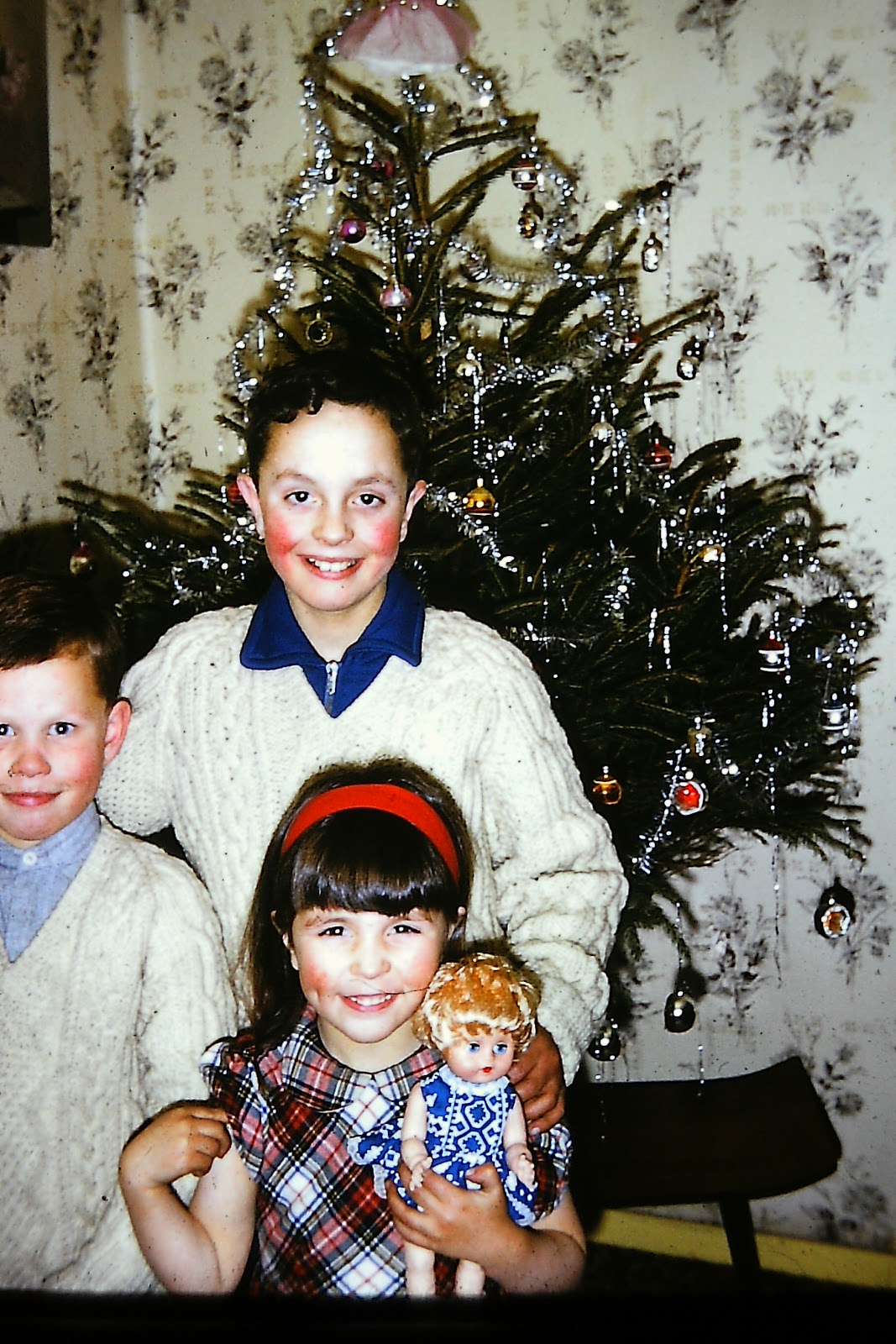
By then a good fire was blazing in the grate and one of the nice things about Christmas Day, compared to our Sunday visitations, was that we got to stay on a little longer into the evening. Our grandfather would give our great-grandparents a lift back home to London Road, Dalkeith, before then returning the seven or so miles back to Portobello to give the Hoffmanns a lift back home to Oxgangs Avenue and The Stair. It was of course a stark contrast coming home to 6/2. The house was quiet. It was cold, but slightly more inviting than usual, because the Christmas tree decorated the corner of the living room and we had the pleasure of going back to our presents.

Monday, 24 December 2012

Christmas Eve

When Anne Hoffmann, Iain Hoffmann and I were young, whatever our circumstances - whether our father was in work or not - Santa Claus always did us proud.

Christmas was always the best and most exciting time of the year.

When I say that Santa (aka Mother, Mrs Anne Hoffmann) - sometimes with support from Father (Ken Hoffmann) did us proud I don't mean that we were spoiled or received any expensive presents - no, instead we always got a stocking which was filled full of imaginative small presents which were an absolute delight to wake up to.


Like most kids it was the one evening of the year when we were keen to go to bed early of our own accord.  And of course it was the one morning in the year that we were keen to get up early too!


I'm not too sure how it worked in all the other households in The Stair.

In terms of quality high spend presents Norman Stewart (6/3 Oxgangs Avenue) did better than any of the other children.

One feature which I didn't enjoy at school was that on our return in January the teacher always asked us all individually, in front of the class, what we had received.

I can recall telling a fib saying that I had been given a graphic designer's set - of course I didn't have a scooby what that was but I was determined not to be out-gunned by Norman - he of course was the one pupil in the class who knew perfectly well that I had not received any such thing!

In my memory Christmas Eve was a very quiet evening in The Stair. 

I can recall my father regularly going out to the Christmas Eve Watchnight church service, presumably at Colinton Mains Parish Church, the same church which the Swansons attended - I don't think he went to the remarkable Reverend Jack Orr's St John's Church service.

Colinton Mains Parish Church


St John's Churdh of Scotland, Oxgangs Road North

Rev Jack Orr
The Hanlons (6/7) always seemed to receive some quite nice presents and they might be seen out playing with them, but not until several days after Christmas Day.

Over the years Mother and our next door neighbour Mrs Molly Swanson (6/1) had an arrangement whereby Mum gave Gavin and Heather a wee tin of Woolworths' toffees and we all received something from Molly - as mentioned I once got a book from her, but when it was opened it instead contained seven tubes of sweets inside arranged horizontally inside.

The Hoggs up above (6/4) always received girly pressies and I can recall my sister Anne spending time with Christina, Maureen and Eileen. I'm much vaguer on the Blades (6/6), other than one year when Alison, Ruth and Esther got their Spacehoppers.

.
Presumably before Anne was born our grandfather gave Iain and me a bobble Santa each which were full of wrapped toffees - the figure is a delight and has been carefully looked after over the past fifty years - each year we bring the two Santas out. The Swansons got a similar Santa figure, but they had less jolly faces.


I may be wrong but I seem to recall that the Hanlons and the Blades were quite big on such decorations as the linked rings which went from corner to corner across the ceiling.


I used to regret that we were more conservative with individual Woolworths' decorations which were very attractive and aesthetically pleasing. There wasn't such a crowded effect which as a boy I would have liked. I suspect Woolworths did Mrs Anne Hoffmann and many other parents proud over the decades.


On Christmas Eve each of the three of would leave one of our mother's nylon stockings at the foot of our beds.

I was always the first of us to awake.

I would crawl down the bed and reach out to see if Santa had arrived yet and then the excitement of feeling the bulkiness of the mis-shapen stocking full of surprises was the most wonderful sensation in the world It's Christmas! I would bellow out It's Christmas! as I jumped down from the bunk bed to switch on the light and awaken the others.


The stockings were just great - they were filled with torches; little games; Yogi Bear or Huckleberry Hound picture books; perhaps a young person's novel; colouring books and pens; a selection box; some gold coins; an orange and an apple and a half crown; The Broons or Oor Wullie annual in later years.

Photograph courtesy Heather Lawrence

Anne would get some girly stuff - I particularly recall a delightful peach smelling cream; whilst Iain might get a toy car, perhaps a Corgi or some Matchbox cars; on one occasion when quite young I got a leather football and football boots. Iain was very into his cars whilst I was uninterested in cars, although ironically I have had more sports cars over the years than one could throw a stick at, much to my wife's dismay.


When we were very young, in our innocence we'd then rush through to awaken our parents to show them what Santa had brought us.

These Christmas mornings were simple little affairs, but wonderful - our mother ensured that these were magical occasions every year from being very small children and into our teens; happy times and very, very sweet memories, which I've never forgotten.

Much like Sundays, on Christmas Day we saw very little of what went on in The Stair because our grandfather would collect us at mid-morning and take us down to Portobello for the day, not returning till late at night - but for that you'll all have to be patient children and wait until Christmas Day to hear that story!

Wednesday, 19 December 2012

Letters From Abroad


I always thought the Blades family lit up The Stair-they were great fun and always seemed to be very go-ahead. One of their innovations was writing to pen-pals in the United States, which must have gone beyond just writing, but actually meeting up. On Saturday, 5 August, 1972 Liz introduced me to her American pen-pal, Lisa. They soon had me doing the same and introduced me to a girl called Peggy Burbank from New York; over the next year or two I was exchanging letters with her.


Receiving letters through the post was a thrill, particularly with the foreign stamps. These were the days before mobile phones were even a dream, never mind the internet, Twitter, Facebook or blogging.

On balance the world's much better for the improvement and speed of communication. Waiting on tenterhooks for the postman to drop a letter through the door from a girlfriend or boyfriend was a wonderful thrill-however if it didn't arrive one had to wait a whole twenty four hours; it was agony and one had to be patient and endure. 

Writing a letter did mean that one was perhaps a little more considered and there was a delay before the finality of posting the letter through the post box down from Dr Motley's surgery. And, because there wouldn't be an uplift until the following morning one could delay sending the missive. Today it's too easy and immediate to press the send button or the publish button on the blog. Even now I feel that slight hesitation-what are the ramifications?

Whilst in the short term the immediacy of communication is wonderful, in the long view having letters from forty years ago opens a window on the past-people can speak to you from beyond the grave, so to speak. 


My father Ken Hoffmann was a wonderful letter writer. My grandmother was always encouraging him to write about his adventures across the seven seas. He wrote to me from America, Japan, China, Australia, Argentina and Romania to name a few. 

And, as the saying goes, When I was sixteen I thought my father knew nothing; by the age of twenty one (or fifty six) I was surprised at how much the old man had learned!

Tuesday, 11 December 2012

Saturday Afternoons - You Grunt, I'll Groan!

Can you have a relationship when neither party speaks to each other?

One relation who hasn't really featured thus far in the series of blogs is our great-grandfather Willie Wight. 

He lived until his early nineties as did his wife, known affectionately by we great-grandchildren (Anne, Iain and me) as Wee Nana. They lived all their married life at London Road, Dalkeith in the upstairs part of the building. It was a solid, well built house-it's a listed building and is still there today.


The house was situated opposite the old Stewart's Shell Garage. I fondly recall looking out the windows at the petrol pumps with the old shell design on top of each pump. The coal fire would be blazing giving off a grand heat on a winter's afternoon.

'Saturday Afternoons, Dalkeith' (Peter Hoffmann, 2004)

Willie Wight was a remarkable craftsman: as a blacksmith he created gates and railings for prestigious projects and as the town locksmith could open bank doors if the local bankers mislaid their keys.Willie Wight was also a miser. In his bedroom he kept a safe next to his bed - fascinating, if one had the bottle to sneak in - the difficulty came if he or someone else might enter his room - you would be cornered unless of course you were to dive under the bed!!

One Christmas down at Portobello at Grandma Jo’s he tried to slip me an old penny as a present. I looked at it, considered it, then returned it to him and said 'No thank you!' He laughed so he wasn't entirely without a sense of humour (returning the penny to his waistcoat pocket), although 1958 may have been the last time that he smiled; to me his de-facto demeanour was taciturn and silent. But he highly regarded my father Ken Hoffmann - because of his exploits on the seven seas I expect he thought he was a real man!


Our grandmother and grandfather (Josephine and Willie) visited them every Wednesday and Saturday afternoon to give them a hand, do some shopping, cook meals and check they were okay.

My Aunt Heather was usually always there on a Saturday and occasionally my mother too.. I liked spending any weekend I could with my grandparents so I quite regularly visited on Saturday afternoons when I accompanied them. 

I always enjoyed visits to Dalkeith -it's a small market town with an interesting history - it always has a nice feel to it. Many of the buildings were old and stone built - it was quite different to the grey housing schemes at Oxgangs. Between the years 1989 and 1996 I had an office in the town working for Midlothian Council.

On the Saturday afternoons everyone disappeared out shopping - buyng mixed sweets from Woolworths; triangle shaped scones at the baker's; and fish for the afternoon tea. I meanwhile sat in the sitting room with the silent one - we called him Pumpa - a great moniker eh! 

But really, he never spoke. Like Grandpa Broon, but without the whiskers, he sat under a great cloud of pipe-smoke. Similar to the smell of cigars which take me back to 1960s with Pumpa, Gaga and my father sitting in the front room on Christmas afternoons I similarly liked the smell of the pipe tobacco.


The boxes of matches he used always interested me because they weren't the Bluebell Matches we used at home or Swan Matches with which my grandfather lit his cigarettes with. I was fascinated by the different designs on the boxes. I suspect he bought them from his local pub, The Black Bull.


He always had sweets on him which, similar to the matches,  I hadn't come across at Ewart's Newsagents at Oxgangs Broadway.The sweets were liquorice Pontefract cakes - believe it or not he might very occasionally deign to give me one (thus at least acknowledging my existence) which I enjoyed, particularly the taste and the consistency. But more usually he would feed himself and simply ignore me - well he was born in the age of Queen Victoria - children should be seen and not heard!.


Although many people would have found it an unsettling environment I was quite happy - I knew where I stood with him - there were no surprises.  We'd settle down to watch the wrestling, listening to Kent Walton's  low keyed Canadian accented voice providing the commentary on Jackie Pallo; Mick McManus; The Royal Brothers, et al.

He would then switch over to BBC where we would get David Coleman talking as the teleprinter gave out the early football results. The full results were then read out by Tim Gudgin who had as memorable a voice as Walton's.


I enjoyed the wrestling and in our way we communicated - we both wanted the outrageous Mick McManus to get beaten and we both agreed not to speak to each other unless he offered me a sweet when I would say 'Thank you'..


Friday, 7 December 2012

Adolf Hitler Kept Me Out Of The Hunters Tryst School Football Team!


This is a more difficult and sensitive blog to write.

At Hunters Tryst Primary School I had three main teachers - Mrs Berwick; Miss Sulley who I've written about; and Mr Hoddinott. And also for a short while we had an interesting young teacher called Miss Bateman. Miss Sulley was the most interesting and influential, yet it is Mr Hoddinott that I recall most immediately.

Miss Bateman (right)

Over thirty years after leaving Hunters Tryst in 1968 I came across an article in the Edinburgh Evening News about Mr Hoddinott's wife, a lady called Jenny (Jan).

She was about to embark for a very special funeral to be held in the Dutch town of Wins for three brave airmen who had gone down with their RAF Bomber plane over wetland in the Netherlands thereby avoiding hitting the local town. The plane had been returning from a bombing raid over Germany. On the flight was Mr Hoddinott. I came across the under-noted remarkable story:


HODDINOTT, Howard, Harvey, Flt Sgt, 1344173 - Served in WW II with the RCAF. His aircraft was shot down over Holland May 5, 1943, when the Vickers Wellington ([9]) bomber he crewed in was intercepted and hit by a German Messerschmitt Bf 110 ([10]) fighter aircraft. After the crash he was captured by German soldiers and survived two years as a POW. Freed at the end of the war he recovered in a hospital in Britain where he met a Scottish nurse (Jenny (Jan)) who became his wife. He then enjoyed a career as an educator in Edinburgh, Scotland.

This story stopped me in my tracks.

I was completely unaware that Mr Hoddinott had been a war hero, fighting for Canada and therefore Britain as a young man. I am full of admiration and gratitude for what he did for Britain and the future generations who have been able to enjoy a life free from Nazi Germany suppression.

It was fascinating to discover that he came from a well known family in Newfoundland where he was raised; several of the young men from the island signed up.

It's strange the way life pans out - if there had been no Adolf, then Howard Hoddinott would never have gone to war, never met his wife, never have come to Edinburgh and perhaps never have trained as a teacher and of course never taught at Hunters Tryst Primary School.


Unfortunately, at best I had a very mixed relationship with Mr Hoddinott; at worst, one where I suffered under him.

He was our class teacher in P6 and P7.

In some respects I really enjoyed his classes, particularly during P6.

For example, the class would regularly listen to the Schools Radio Religious Service BBC Broadcast first thing in the morning. Immediately after the broadcast he would facilitate a class discussion for half an hour or so. He would take a point from the broadcast and with contributions from the class skilfully develop the particular to the universal - the point to the principle. This was a fantastic approach to education, because it's what education is partly about - drawing out children rather than just informing them. The discussion could end up going in any direction and I found it very stimulating.

I loved these sessions and ironically may have been the biggest enthusiast in the class. I had my hand up most of the time and was a very willing contributor. And young as I was, I understood what he was doing and appreciated the maturity of the approach which he was taking to education - in some respects he was ahead of his time, particularly reflecting recent developments in Scotland under the new Curriculum For Excellence.

I generally enjoyed the rest of the lessons, whether it was English, Arithmetic, etc. 

What I didn't enjoy was that he had to teach taking cognisance of a class of very mixed abilities. 

There were ten or so very able pupils in our class and then some significant gaps to the more middling students and an enormous gap to the less academically able pupils. 

This often meant that a lot of pupils had finished their work well ahead of others. 

As this was often the case, sometimes I got a bit bored and would get up to some low level mischief - usually it was just talking to others; surreptitiously eating Sports Mixtures, Black-Jacks or Fruit Salads; or mucking around; sometimes I would actually be trying to help out some of the bad lads who tended to struggle.


My relationship with Mr Hoddinott deteriorated because of this. 

Today, I can understand how annoying and frustrating low level disruption can be for teachers, however I would have been too feart to engage in any serious misbehaviour. 


Mr Hoddinott was a tall, balding man; he had a very serious disposition and was an imposing figure. Those were the days of the Lochgelly - the leather strap and he could dish that out with the best of them as I know only too well to my cost. He was not someone who I would step over the mark with.

My relationship with him changed dramatically for the worst in P7, after a particular incident. Thereafter, it deteriorated and from then on I felt I was a marked man.

To his credit Mr Hoddinott ran the Hunters Tryst School Football Team. 

There was a wee team composed of P6 boys and the big team which was made up of P7 boys. 

Initially I played for the wee team on the right wing. 

When I first received my purple and yellow horizontally striped football shirt I paraded in front of my mother's full length mirror. Combined with white shorts, long white socks and my classy Adidas La Paz football boots I was like the cat with the cream!


My joy wasn't to last however. 

Mr Hoddinott dropped me from the team after only one game! 

I was devastated, because playing for the school team was probably the most important thing in my life at this time. 

Mr Hoddinott told me he didn't like individuality - despite the concept of the position of winger being to run down the wing, beat players and cross the ball into the box. I'm unsure how much football was played in Newfoundland, so each of us grew up under different sporting philosophies and cultures and therefore had different interpretations and attitudes on how the game should be played.

Football was the game at school and we played every lunchtime and break; getting dropped was a talking point in the school playground. I thought it unfair - well I would of course! However to counter my natural bias my peers regularly picked me first for teams in bounce games. I was the only boy allowed to play with the much older kids in the evenings. I worked very hard on the pitch, could out-sprint any full backs and also run all day too. 

As Mr Hoddinott ran the team and was quite an authoritarian figure there was no way to appeal his decision. 

My sense of impotence, frustration and disappointment was endlessly drummed into me each week. 

The football strips were stored in plastic bags in a long cupboard in his classroom. 

Every Friday each boy would come into the classroom at lunchtime to collect his strip. 

I may be wrong, but I sensed Mr Hoddinott noted my dissonance - this is more instinctive than intellectual but I also sensed he seemed to enjoy an element of Schadenfreude in this matter. 


I thought I would have to endure this omission in P7 too. This would have been even worse because the big team's strip was beautiful. It was purple with a yellow V on the front and back - and beyond imagination, a white number on the back to set the outfit off! 

Of a sudden, there was a ray of hope - unbelievably Mr Hoddinott announced at the end of P6 that he had decided to give up running the team  The role was to be passed on to a local man, Mr Sandilands. He was a policeman and a very pleasant individual.

Mr Sandilands must have been keen to consider his options by holding a trial. Mr Hoddinott sent Mr Sandilands a team list composed of the Probables versus the Possibles. My name wasn't on either list which I felt was unjust particularly as there were some duds in the Possibles team. 

This wasn't quite the end of the matter however. The trial was being held at Colinton Mains Park in the first week of school after the Summer Holidays. 

I turned up with my gear. 

When I was told by Mr Sandilands that my name wasn't on the team sheets, I said in all innocence that 'oh!, there must be a mistake.'

Early in the first half Mr Sandilands brought me on as a substitute and put me in to the Possibles team. 

By half time we were leading five nil and I had scored every goal. At half time I was then put in the Probables team where we managed to pull things back.


The finale to all this was played out a week later. 

As mentioned the school football jerseys were stored in a cupboard in Mr Hoddinott’s classroom. 

On the Friday lunchtime an envelope arrived from Mr Sandilands addressed to Mr Hoddinott. 

It contained the team lists for both the wee team and the big team. 

I’ll never forget the surprise on Mr Hoddinott’s face when he opened the letter and discovered my name at Number 10 - the position in the team. 

I read his mind: How had Hoffmann pulled this off? He glanced up and looked at me with distaste as I walked out to collect the number ten jersey. Unlike the Schadenfreude he had enjoyed a year earlier, mine was purely a boyish joy and innocence at being picked for the team. Thereafter, I enjoyed a full season playing for a successful Hunters Tryst team

After this in class discussions he never asked me to contribute any more, which was frustrating.

I regularly received the belt for small misdemeanours

Later in the school year he put my desk outside the class-room in the cloak-room for a period of about three months. He said I was a disruptive influence in class.

Undoubtedly I was on occasion, but the punishment felt gross and out of proportion. I was a keen pupil and always very prepared to contribute. He of course had to teach to all standards of ability. I was relatively bright and picked things up quite quickly. But I was certainly no more disruptive than many others and those often tended to be kids who were less able. It was easy to get bored if you had finished exercises early. A better approach today would be to use kids who are good at particular subjects to work with kids who are perhaps less able.

The punishment felt over the top and my interpretation, rightly or wrongly, was that it related to me getting one up on him by outmanoeuvring him by getting back into the school football team.

Thereafter, I was isolated from my class mates and lessons.

It also meant that I fell behind with some of my lessons - particularly in areas such as maths, which use building blocks. It meant I was unaware of certain formulas or unable to tackle particular problems not knowing what some symbols meant. 

Because this was an age where there was a lack of transparency and communication my parents were completely unaware of what was going on. Looking back on the episode it was abusive and I was victimised by him. 

I was brought back into the class when we had to sit the eleven plus test. 

It was not long afterwards we all received a small brown envelope. 

For most of the class it meant they were going to the local secondary school, Firhill. However, for a good handful of us, the letter said we were going to Boroughmuir Secondary School.

I was ready to leave primary school and both excited and daunted at the prospect of going there. 

Even the thought of getting the bus to school had a certain appeal to it too. 

My father, Ken Hoffmann, must have been pleased because it was his alma mater, but he seemed to take it in his stride as if it were expected.

Reflecting on this, I was clearly a boy who misbehaved sometimes at school and should have behaved better; that needed to be addressed. But Mr Hoddinott should have included me in the list of boys interested in being considered for the team and certainly not have put me in the cloakroom for three months, which was straight out of Nicholas Nickleby!

Although Mr Hoddinott extracted a modicum of revenge in my final year at primary school, I felt  the real victory was mine. 

What remains in the memory, when we returned in the late summer of 1967 to Hunters Tryst School is that sweet moment on a glorious Friday lunchtime in late August when I discovered I had been re-selected for the school football team; and of Mr Hoddinott reading out the teams and announcing through gritted teeth, that I was playing at Number 10. 

Did one of us or indeed both of us have a Pyrrhic victory - I suspect so?

Postscript: This is of course my remembrance and interpretation of Mr Hoddinott - I'm sure others had a very different experience and in the interest of balance I would greatly appreciate any others' views.


Sunday, 18 November 2012

Not Swimming, But Learning!

One possible divide in The Stair was the children who regularly went to Warrender Swimming Baths and those who didn't. There may have been a cost dimension for some of the children, but generally many of the children managed to get the bus fares and entrance money, if not money for secondary spend.

I cannot ever recall seeing Heather or Gavin Swanson ever going to the baths. Even if they had the inclination to go they never seemed to have the freedom that all the other children enjoyed once they got to a certain age-the interesting dynamic of control was clearly a factor there which as a parent I can now understand. Looking back, for many of us, being able to go swimming without parental supervision was a right of passage. It was another example of the inordinate freedom to roam, that certainly The Hoffmanns were able to enjoy. Because our father would have done the same at the Glenogle Baths at Stockbridge as a boy in the late 1920s/early 1930s, it probably wasn't considered a health & safety issue in our house.


I don't remember seeing The Hogg girls Christina, Maureen or Eileen going along; similarly The Blades and The Duffys. Generally speaking there seemed to be a gender split, because the children who attended regularly were boys-The Hanlons-Michael; Boo-Boo; Colin; and Alan; and Iain and Peter Hoffmann, as well as Ali Douglas (8/3); Les and Derek Ramage (4/3) and many others.


Iain and Boo-Boo were great pals and for several years they used to go along together weekly It was the one activity that Ken Hoffmann used to very occasionally come along with us. He was an excellent swimmer, with an effortless, smooth and powerful front crawl; but it was his diving which attracted great attention. Because the deep end was only six feet deep, unfortunately, all that Warrender Baths had back in the 1960s was a small spring-board-but even from this he performed lovely swallow dives. I enjoyed watching him perform these. What I didn't enjoy was when he might swim under water and suddenly take my legs from me and pull me under the water. I couldn't swim at that stage so it was always a scary experience.

The bold Ken Hoffmann diving off the bridge of a ship

One distinctive memory for me about how life might have been, was when he had the loan of a black Riley car. It must have been during the autumn school holidays-the tattie holidays. It was a wet, overcast Friday. Over lunch he announced that the three of us-Anne, Iain and I would go swimming at Warrender Baths. It was a great feeling to be driven in luxury, rather than queueing for buses and then walking to and from Bruntsfield Place to Thirlestane Road in the rain. We were driven straight to the door! Even the route he took seemed to be magical-through the Braids, Cluny, Blackford and then Marchmont. And the luxury of a chilly bite and then chauffeur driven home!

We usually always treated ourselves to a chilly bite after our swim-it was a hot chocolate drink from a machine which cost sixpence. We really did shiver after our swims so it was welcoming initially, but I usually found it a bit sickly toward the bottom of the plastic carton. There was a rather classy shop with a a lime green painted façade (probably Farrow and Ball paint!) called Elizabeth's at the top of Thirlestane Road from which I'm ashamed to say we used to nick sweets from-perhaps because she was used to a better class of clientèle it was as easy as stealing sweets from a baby.

Edinburgh Corporation were very go ahead with their swim lessons programme which were usually held during the school holidays. For this one would usually be issued with a swim pass on the last day of term dated for say the two weeks of the Easter Holidays which gave one free access to the baths. It was on one of these occasions at Bruntsfield Primary School (Sean Connery's old school) where they had a pool in the basement, that I first learned to swim-what a feeling! The instructor obviously realised I'd mastered the stroke, but didn't have the confidence. He gave me water wings to put on for confidence-what I hadn't realised was there was no air in the wings-bright or what?


After that one was able to make progress through their swim development programme-a lovely certificate for swimming a length-thereafter it got progressively more difficult, but because the certificates were so classy, one wanted to get better to obtain them-back to my collector tendencies! Anyway, I managed to get certificates 1, 2 and 3, but never sat no 4 which included life-saving at a higher standard than level 3. Part of some of the tests included diving for the heavy rubber brick.


Aye, if we weren't swimming we were learning and if we weren't learning we were swimming!