Comments

'And finally, not everyone’s being doing topical. In fact, here’s the rather lovely 6 Oxgangs Avenue devoted to the history of the development of the area, this week highlighting how the block of flats came into being. Could have been prompted by Who do you think you are? Or just a timely reminder that not everything worth blogging about is in the here and now.'

Kate Higgins, Scottish Roundup 26/08/2012


Showing posts with label Orr Rev Jack. Show all posts

Monday, 2 December 2013

St John's Church-An Update


Anonymous Comment


A well written piece Peter, again the memories came flooding back especially when I saw the photos. I am scared to admit that under the second row of seats my initials may still be scratched into the wood a sign of a misspent youth or a dare I can't remember.

It is ironic after all the publicity given to Colinton Parish Church over the R.L.S statue that another icon of the area St Johns is near the end of its tether.

All the better off locals used to go to Colinton Church those who were able to afford to live in the area, Colinton was quite an exclusive scheme back in the 50 and 60s and the more working class stayed in the council scheme e.g. Oxgangs the main advantage living in Oxgangs was we had a pub and a bookies they had a better address.

I knew a few teachers at Firrhill Secondary who stayed in the Colinton area, I can't recall any staying in Oxgangs.

Do you re-call the pour-oots the newly weds used to toss to eager bairns fighting each other for the best spot nearest the bridal car? The photo of the stairs strewn with Autumn leaves reminded me that a surprising amount of money used to end up at the bottom buried under the debris that used to collect in the centre as in the photo; some times if you were really lucky and the conditions were right you were able to see two mini tornadoes swirling the leaves about 

The amount of money that used land on the main road was unreal Health & Safety would be in their glory if that happened to-day, the danger of being born in the 50s is that I think we had more common sense than the generation of to-day ,you had to just to survive, a skelp on the lug is a good teacher so is a week's grounding especially if the schools were mid term.

I also remember after the pour-oot the queues in Ewarts the sweetie shop full of kids who couldn't wait to be parted from our pocket full off halfpennies, pennys, threepenny bits and silver sixpences. I remember once getting a two bob bit and thinking all my Christmases had come at once. In those days you could get a 16 bus to Morningside then get into the Dominion picture house to see the latest film (in my case it was Goldfinger)and buy a cone for about 5 shillings "25p"to the younger ones then get home and still have change.

It will be sad to see the demise of St John's even though I moved away in 1975 I still have very fond memories and that is something that can't be taken away, I will be at the service to-morrow, and also get some more photos to go with the ones I took at Hunters Tryst or what was left. I wonder what the next part in Oxgangs to vanish will be-is the air raid siren at the 27 bus terminus still there ?

Saturday November 23, 2013

Anonymous Comment 

Hi Peter, 

Well I attended the Thanksgiving Service today at St. John's. It was a lovely service and well attended. However, what I am interested in is your associations with this Church? Did you or Iain go to one of the organisations connected with it, Scouts or Cubs? Or was your father an occasional visitor to the Church? I know he used to join Churches from time to time especially when he was trying to stay away from the drink. Apparently the ground is being sold probably for the building of homes for older people and the Church demolished. A pity because it is a lovely church, so simple and with lovely clean lines internally. I know the local Fellowship church people wanted to buy the property but the Church of Scotland weren't having it. The Fellowship people have the old hall that was part of the Episcopalian Church, St Hilda's was it, which was demolished and houses built there. They hope in time to raise enough money to build a church of their own. Some people know them as the happy-clappy people. Local people and some of their family are pastors in that church. Next Sunday there is to be a joint service at St. John's with the Colinton Mains Church congregation followed by a lunch, like today, soup, bread and cheese, tea/coffee and fruit cake, but good company. I was sitting across from Jason Rust our local Conservative Councillor locally known as the Boy Wonder. Regards.  

Sunday 24 November, 2013

Comment From Ruth Kaye (Blades)

Hello Peter,

Sad to see another church close but guess time waits for no one wonder what they will do with the building?


Sunday 1 December, 2013

Comment From Lesley Orr

Thanks for your fascinating blog, evoking so well the story and spirit of Oxgangs in the 1960s and 70s. It has been particularly touching to read your reflections about St John's church, and especially your very kind words about my dad Jack and mum Janet Orr. As you note, my sister Kathy preached at the service last Sunday (and she quoted a wee bit from your blog!) I was there too, along with our brother Callum (whom you remember was also an athlete, and is now a headteacher in Loughborough). My husband Peter Macdonald, and Callum's son Colin were also there to represent the extended Orr family. (Brother David lives and works in London and wasn't able to be there). It was a lovely occasion, and of course a day of mixed emotions for us. I still live near Edinburgh, and have revisited St John's on occasion over the years. There are still many old (and getting older...) familiar faces who have been in Oxgangs since the early days, and there is always such a warm welcome from these good friends. People remember my parents with such love and enduring affection - and it means a lot to us to read about the positive impression and impact they made on folk who were not directly involved in the church.
Apart from the emotional connection I feel with the building, which holds so many happy memories, and which has been the space where so many significant markers in my life happened (I was the first baby baptised in St John's - in the hut which was used before the Riach building was opened - and was married there too) I love the clean and elegant lines, the combination of warmth and light, the fantastic chancel space. It speaks so eloquently of the spirit of optimism, hope for the future, participation of all, and community building which characterised the best of Oxgangs in the 1960s and 70s - and which your blog also captures.

I certainly remember the pouroots, the church fete, concerts and so much else...Keep on sharing the stories and pictures!


Sunday 1 December, 2013

Friday, 22 November 2013

St John's Church-For Whom The Bell Tolls, It Tolls For Thee-An Update and a Special Church Service, 24 November, 2013


On the last day of December, 2013, the St John's Church, Oxgangs church bell will ring out one more time before becoming silent.

Last Sunday on a beautiful sun-kissed, mid-November morning I stopped by to hear the bell ring out for perhaps the very last time for me. 

It was a still and frosty morn. 

I walked the 360 degrees around the church and the old church hall and then entered the Narthex or vestibule inside St John's and unobserved, watched an elderly church warden making ready for the church service. 

The gentleman wore a jerkin and cloth cap, but was as tall and erect as a (old) soldier. He walked up and down the side aisle; at one stage he carried a kettle; and then some plates and also some other objects. 


Previously he had laid out the Order of Service at the front door of the church.


And all the while as he performed his duties he sang to himself.

He was oblivious to me standing there. And whilst he had a good voice it could be better described as a happy voice. 

His happiness and joy could be heard in that voice.

He was at one with himself. 

It was clear these were not really duties for him, He was so happy in making a contribution. 

I recalled the Latin phrase - ora et labora - to work is to pray. 

It turned out that he was the church bell-ringer too - who says men can't multi-task! 

The church bell rang out five minutes before the service commenced, ringing out, calling the parishioners to worship. 

The elderly gentleman then emerged from the door of the bell tower and glided up the path to enter the church by a side door to join the congregation.

The congregation was very small and the average age must have been around seventy years of age 


There was a feature on BBC Radio 4 the other morning saying Christianity in the United Kingdom may be dead in a generation. My visit brought this home.


Shortly before the service began I spoke at the top of the steps on Oxgangs Road North to a lovely and very pleasant older lady

I mentioned that as I was in Edinburgh I was keen to hear the sound of the St John's Church bell ring out one last time and to record it for posterity. 


We exchanged some memories of times past. 


She has attended St John's for many decades, indeed since she first lived at Redford at the army houses back in the 1950s. She pointed out to me another parishioner who had attended the church each Sunday since St John's first opened in 1957, the year after I was born.


I spoke of happy memories of the annual summer fetes and the marvellous contribution made to the Oxgangs community by the Orr family - the Reverend Jack Orr and his wife who had taught at Hunters Tryst School, also sadly no more. 


The lady spoke to me about her sadness about the church closing on Auld Year's night and the challenges of joining up with Colinton Mains Church and how very good the incumbent minister, the Rev Iain Goring has been. 

She became quite emotional and I held her hand.


On a note of serendipity, she told me that next week, the Rev Orr's daughter, the Rev Dr Kathy Galloway, will be a guest preacher at a special church service (Sunday 24 November, 2013 at 11.00 a.m.) to celebrate the church's existence in Oxgangs, to be followed by a lunch in the church hall. 

Whether one is religious or not it's perhaps something to consider for anyone interested. Special occasions should always be acknowledged and marked.

John Donne has been mentioned by me before, particularly on a blog about the end of our school days at Hunters Tryst. And once again the sound of a church bell ringing out signifies something important; for when Donne spoke of 'For Whom The Bell Tolls, It Tolls For Thee', it does indeed because when something dies, we all die a little; I guess what Donne was really saying was that whatever affects one, affects us all....

Friday, 25 October 2013

For Whom The Bell Tolls Number Two-Comments and a Response

Comment From Alan Brown:
Hi Peter, I was christened at St John's by the Rev Orr in 1967. I have a photo of me with my parents, brother and Auntie standing outside. Sad to hear this news, another link to my past slowly fades away.

Comment From Anonymous:
Hello Peter 
I also was a member of St John's Church even although I was christened in Colinton Mains in 1956. I remember the concerts that used to be held in the main hall for the local community and also the BBs, the 17th I think would meet there as well as the Life Boys as they were called in the old days. 
I went to bible class then progressed to the big church.
My most abiding memory was the annual fair held in the grounds and the main hall where all sorts of stalls were set up to raise funds for the church everybody used to turn up even teachers from all the local primary schools catholic and CofS, Oxgangs was a real local community in those days everyone knew everyone else.
Unfortunately In this day and age those days are sadly gone but thankfully the memories remain, good and bad but in my case the good outweighs the bad.
I notice that they are talking about closing the police station in Oxgangs, ironically I have the same scenario up here with my local station, so much for progress, sorry cost cutting, as Alan B said another link with the past fades away.
I think I will have a trip to Edinburgh this weekend and take some pictures of St John's before it is turned into a building site.

Keep on doing the The Stair Peter you are slowly jogging the memories out of me that I thought were long gone Thank you. 

Response:
Thanks for your very interesting e mail.

Because I drew down the curtain on Hogmanay 2012 I never got around to doing a variety of planned blogs-your e mail touches on some of them. Like you I too recall with great fondness the St John's Church Fete held annually each June-it really was a highly enjoyable day out. Looking at the area of the church it couldn't have been that large, but in my mind's eye it remains so. I vividly recall the bendy 'electric wire' (battery operated) that one tried to take a handle with a ring on the end from the start to the finish without the buzzer sounding-not often achieved as it took a steady hand-certainly beyond me today as it was at the time. 

The ice cream sold was always very pleasant and like the occasionally held fete day at Colinton Mains Church they held a sprint race for boys and girls on the grass area adjacent to the church building-I still recall receiving a colouring book and paints as a prize. There were excellent stalls selling all sorts of serendipities-it was from here and long before eBay we garnered our knowledge of ancient Dandy and Beano annuals. 

They always seemed to be very lucky with the weather; they really were sunny occasions and the volunteers-presumably church goers were equally sunny in their disposition, smiling and friendly-a really great and lovely day out for all the family-it must have warmed the heart of the Rev Jack Orr as he strolled amongst the happy crowd.

Similarly, I also recall performing in local youth club drama productions at the church hall-it was also probably one of several venues for The Pentland Festival-a blog which I really should get around to. 

Writing this wee response and your planned visit to Edinburgh has just given me the idea to record the sound of the St John's Church bells before they are perhaps silenced for ever-I'm due to be down next month so will need to brush up on the technology.

Thanks again for your comments-keep in touch!

Best.

Peter
*:) happy  

Wednesday, 26 December 2012

Figures On The Edge No 3-James Duffy and Esther Blades; Colin and Alan Hanlon; The Sibbalds; The Douglases; Rab Moir; The Ramages; The Robertsons; Reverend Orr; and Mr Russell

As I move toward winding up the blog I thought I must do a quick Cooke's Tour of some figures both from and also, for good or bad, closely associated with The Stair

James Duffy, Esther Blades, Colin and Alan Hanlon haven't featured significantly in the blog only flitting in and out occasionally. I'm not entirely sure why this is. If I were to have kept it going into next year for another six months I'm sure they would come more into prominence. It may also be because they were four of the youngest children at The Stair-James and Esther were the two youngest children.

There's no excuse for my lapse with regard to James. It's only because I was checking out some dates for the recent blogs on spring and summer and was skimming through some of the journals from over forty years ago that James' name cropped up. He was a very pleasant lad.

James Duffy
Esther should have cropped up far more often even though she was the youngest member of the forty one people who stayed at The Stair. I usually associate her with Ruth-they were the two youngest members of The Blades family and played together regularly. As previously mentioned I can recall taking the two of them on a few bus outings into town-they were both good fun. There are a few references to her in old diaries often just a group of us talking casually whilst hanging out at The Stair or through attendance at the church. Being the youngest at The Stair everyone liked Esther and we all looked out for her-she was a lovely and very pretty girl.

Esther Blades
Colin and Alan Hanlon should have cropped up more often, Colin in particular. He was ages with my sister Anne Hoffmann. He was a very friendly and pleasant lad. He was an enthusiastic footballer and part of the very good Hunters Tryst School football team that made the final of one of the city's premier primary school cup competitions-a group of us went down to watch them play in the final at Warriston Park. I liked Colin a lot-as he got older he occasionally used to stay with a group of us for the Friday Horror Night-more of further down. He was an integral part of all our football games. In later years I sometimes saw Colin out on the town on a Saturday evening!

Colin and Alan Hanlon
Alan meanwhile was one of the three youngest members at The Stair. Similar to Colin he was a nice lad and an enthusiastic football player. Again, I liked him too. However, after I had left The Stair and as people got older, some bonds grew closer and others lessened-I can recall Iain Hoffmann saying in latter years that Alan seemed to be a little more distant than in earlier years. My memory of him is from an earlier time and I always found him to be a charming and likeable lad-as I've said The Hanlons were a great family at The Stair. I may be wrong, but Alan may well have been the brightest of the four Hanlon brothers. I haven't seen or heard of Alan in forty years so have no idea what course his life took.


The first time that death impinged upon our lives at The Stair was at one of the neighbouring Stairs, 8/2 when Mr Jack Sibbald died. I think his death was unexpected. The Sibbalds were a lovely family-very much similar to The Douglas' at 8/3. At that time they had two children Gordon and Dawn. Gordon was a little older than me and was a bright lad with a lot of get up and go-an interesting character. Dawn was younger-she was blonde and had a certain class to her. I recall they were quite unusual in that they went an annual holiday to Milport each year-I think Mr Sibbald was originally from the west. His death came as a real shock-even to we children-I know it certainly stopped me in my tracks and made me reflect-nothing is for ever. The Sibbald family eventually moved to neighbouring Colinton Mains to a terraced house-we clearly still kept in touch with Gordon-indeed when we all went jumping the burn we often joined its route two hundred yards from their house and this section was always known to us all as Gordon's Burn-what a soubriquet! Mrs Sibbald was a handsome, strong and clearly very able woman-to support the family she became a receptionist at Dr Motley's surgery where she was very competent running a tight, but friendly ship. I think she remarried and also happily had another child. The other death that impinged on us a few years later was when Keith and Mark Robertson's father died. They stayed at 4/2 Oxgangs Avenue. His death came as a complete shock too-I recall Mr Robertson as a strong, robust, dark haired man. Similar to Mrs Sibbald, Mrs Robertson too was to be admired because she too went out to work and supported the family by driving a van which delivered small motor parts to a range of garages.

Ali Douglas has cropped up surprisingly regularly in the blog-if someone had said this to me before I started the blog then I would have raised a quizzical eyebrow. It was no surprise however that he was such a very nice lad, because his whole family were absolutely lovely. Ali's dad was an aircraft fitter out at the old Turnhouse Airport so was in employment in the one job throughout the whole period which meant the family will have enjoyed tremendous stability. They were a quiet family who achieved a delightful balance of being very good neighbours, charming to speak to with a ready smile and an innate gentleness. Our key interaction with them was primarily through Iain because he and Ali were best friends-it was always Ali that was invited to Iain's birthday teas and vice versa. From earlier diaries I can see I had some interactions with Ali too-mainly within groups and he has featured regularly in such adventures as .the chip shop; the City Hospital; and the spring Arthur's Seat outing.


Ali had much older sisters and a brother. Alec was the oldest and Jean the elder sister-they were around Douglas Blades and Liz Blades' age-similarly they were both at Boroughmuir Secondary School-they would have been bright teenagers who no doubt applied themselves too-I know that Alec joined the Civil Service, possibly rather than going on to university? If he had, then it's just occurred to me that he would have been the first of all the children in the four featured Stairs at 2, 4, 6 and 8 Oxgangs Avenue-instead that honour fell to Gavin Swanson who went to Edinburgh and then either Cambridge or Oxford. Alec had a ready smile, was handsome and absolutely charming-looking back he may well have the eldest of all the children at the four Stairs. Jean Douglas I recall as being very pleasant and a serious person. In between Jean and Ali was Elaine Douglas who must have been around ages with Fiona Blades. Like Ali, Elaine went to Firhill School-like the rest of the family Elaine had the same lovely, gentle manner, but what everyone will immediately recall about Elaine was that she was drop dead gorgeous! She was absolutely stunning-a beautiful girl with long dark straight hair and a lovely smile.

Front left to right Pamela, Bernie, baby George, Rosemary and Laurence. Dad Laurence and Mum Mary At back

I mentioned in a very early blog The Calder family who lived at 8/5 - there were four children all of whom were older than me - Bernard, Lawrence, Pamela and Rosemary plus baby George. I didn't have a great deal to do with them, but I recall liking Laurence - perhaps he was involved with Douglas Blades in such exploits as racing around the four blocks (four Stairs) pushing an old pram with one of us crouched in it hidden in a blanket? When I met Douglas Blades at the end of October he mentioned that he used to go up to play with the Calders and was envious that they had a top of the range Hornby Dublo train set with a displayed certificate on the wall whilst Douglas had to make do with a Tri-ang.


In the news column I made mention of how Bernard had worked all his life at our beloved Dominion Cinema before dying a few years ago.

The Dominion's chief projectionist Bernard Calder has passed away. The cinema said: "Over the last 44 years he had threaded the projector, prepped the lighting and lit the screens of the Dominion Cinema for tens of thousands of performances. His professionalism, dedication and love for the medium of film made him a pleasure to work with. We will miss him


A later arrival at 8/6 Oxgangs Avenue after the Calder family left Oxgangs in 1966 were the Moir family who took up residence at the flat. I was the first person to meet Rab Moir. Rab will be remembered for his large Alsation dog and love of motorbikes - he was a a few years older than me, but he was small and squarely built - I had a friendly relationship with him and perhaps because I was the first person to befriend him, felt he tended to look out for me. He didn't join in at football or much else, but clearly he had been a player, playing in the good St Patrick's Primary School team; the photograph is from the 1965/66 season taken at the Warriston Playing Fields - Rab is back row, extreme left.

At primary school  I was occasionally involved in fights with the likes of George Catterson-but not because I liked fighting; I'd walk out along the narrow exit from Hunters Tryst School with a heavy heart as I heard the shouts of Fight, Fight! and I espied the crowd vying for a ringside seat for Mark 4 or whatever it was against George or one of the other protagonists waiting for me-the school-bag would come off and the blazer and then the grappling would commence and the fists would fly-the fight would end with whoever got the first bleeding nose or cut lip-usually me!; there was the rare victory against George et al which made it seem worthwhile. My sister was usually my second in the corner proffering a handkerchief. Despite being on the receiving end, by refusing to kow-tow to whatever their demands were they tended to leave me alone after a while and instead pick on other easier more yielding targets. This happened much less so at secondary school although I can recall one bully awaiting me after games at Meggetland because I'd refused to give him one of the rugby balls to play with when we were warming up! Ce la vie!
From the other Stairs I clearly spent a lot of time with boys such as Keith Robertson, Colin McFarlane and Steve Westbrook as well as Jonathan and Willie Taylor from the Stair behind us at Oxgangs Street, but I can now see it was mainly playing football or jumping the burn or going for adventures to the Pentland Hills which facilitated these interactions-whereas I would say people like Michael Hanlon were more friends with these lads.


Les Ramage has flitted in and out of the blog regularly-he had a twin brother Derek-they were the same age as Iain Hoffmann and Ali Douglas-all in the same class at Hunters Tryst School and as mentioned the four lads who owned the original Raleigh Chopper bicycles. Les and Derek always struck me as getting on fine with each other, but their relationship must have been fractious at times because I think they had to be separated at school because they fought with one another-I may be wrong, but I think Derek was then put into a separate class. When we were young I had a bit of an up and down relationship with Derek, however when we were older I grew to like him much more-he's a nice bloke. He joined the RAF on the administrative side. Back in the early 1990s I was quite proactive in organising games of golf at sleepy Gifford and Vogrie-for a while Derek joined the likes of Les, Iain and me. I admired the way that Derek and his wife were committed to bringing up their children in as positive a manner as possible-they're son and daughter were lovely kids.

Les and Derek had an older sister, Carol, who was around eighteen months younger than me-she crops up regularly in diaries-mainly when groups of us hung about around the Stairs and played running games of singles. She also attended the influential Patricia Browne Dance and Ballet School which must have helped launch her career as a professional dancer-she settled in Portugal over thirty years ago. Iain and Les visited her a few times and I recall driving them through to Glasgow Airport to drop them off for the flights.

It's interesting reflecting about those days-whilst I've said how Iain Hoffmann and Ali Douglas were best friends, then equally I'm sure that Les Ramage and Boo-Boo Hanlon might also have said that Iain was also their best friend too-Iain clearly had an easy facility for getting on with people which meant they warmed to his likeability-he still attracts people thus today-my younger son Tom (d'Artagnan) reminds me of Iain in that respect-I think one of the qualities is that they're non-threatening individuals-they're not individuals who are prone to disagree or argue-they naturally look for common ground and for fun.


Les is the one lad from the Stairs that Iain and I kept friendly with in the decades after we had long left The Stair-Iain still occasionally meets up with Les-they've gone fishing together once or twice to the Pentland Hills to Flotterstone Resevoir. Indeed, he dropped by yesterday to wish him a Happy Christmas! Until I left Edinburgh in 1996 I used to organise a nine hole game of golf most weeks-these games were mainly a foursome of Les Ramage and Iain Hoffmann against Mr John Duncan (Mrs Anne Hoffmann's second husband) and me-we enjoyed this Saturday afternoon ritual for a good decade. Sometimes others from the days at The Stair joined us too-as mentioned Derek Ramage, but also Paul Forbes too. Before we got into this habit, in the early 1980s Les, Iain and I along with others regularly played games on the lovely Braid Hills, where if one wasn't hitting the ball well could instead enjoy the spectacular views over Edinburgh.


Les Ramage was a key and integral part of days and nights at The Stair and features in many of the adventures. For several years in the late 1960s and early 1970s we hosted sleepovers at 6/2-once Mr Ken Hoffmann had departed the scene there was a much more relaxed atmosphere at our home-our mother Mrs Anne Hoffmann was really excellent in this respect-our friends liked her-they felt very relaxed and at home in our household-it was a fun, easy going atmosphere and our pals clearly enjoyed hanging out with us-in these years there was rarely a Friday night that there wasn't children staying-for such a small flat-only two bedrooms-friends such as Les Ramage; Ali Douglas; Boo-Boo Hanlon; Paul Forbes; Colin Hanlon and others all stayed on occasion. We fostered these evenings around the Friday night horror film which was a staple for years and years-Dracula; Frankenstein; Edgar Allen Poe's Tales of the Rue Morgue-even in a group and despite our jocularity we were all shitting ourselves watching the films. These evenings would be fuelled with bottles of juice, bags of crisps and chips and sweets and chocolates. Because The Hoffmanns had paper runs or milk runs early the following Saturday morning a bonus was that often the kids staying overnight would accompany us rather than doing a solitary run-for a while we were all decked out in our Woolworths' gold crosses in case we stumbled across Count Dracula in the dark, creepy Morningside tenement flats!

Two important figureheads in the community when we were young were the minister and the dentist. The Reverend Jack Orr was a truly remarkable, charismatic and kind man. Although I never really attended his church, there was always an enlightened friendly light touch to it. For a period I was part of a group of teenagers there who put on a play in the St John's Church Hall at one of the church festivals-it may have been part of the annual Pentland Festival. Our main dealings with him were his weekly visit to Hunters Tryst School to take the weekly service as well as those special staging posts in the year-Harvest Festival; Christmas; and Easter. He did great pastoral work in the community-I don't think he was someone who rammed religion down one's throat-it was more akin to living in imitation of Christ-I guess leading by example-the good life which one could aspire to,too. He was highly regarded in the Church of Scotland hierarchy and at least one of the future church leaders worked as a young apprentice under him. His wife, Mrs Orr taught at the school. I think my sister was in her class. What a contribution they must have made to the community of Oxgangs over the decades.There were children too, one of whom, Calum went on to become a Scottish International athlete.

Rev Jack Orr
Mr Russell was the local dentist for decades. His surgery was located next door to Dr Motley-a very handy arrangement. For all of us at The Stair to have these services located a minute or so walk away was very handy and convenient. I had a relationship with Mr Russell, not a transaction.

I can recall sending postcards to the surgery during the 1970s from such locations as Montreal, Prague and Edmonton when major championships were being held. Part of the conditions of being part of these teams was that we had to have full medicals which were duly signed off for me by Dr Motley and Mr Russell. Ironically my largest memory of the dentist was as a young boy coming round from having received gas looking out at the lovely blooms on the trees and foliage out the large window of his surgery room-it was like awaking in paradise, before I recovered my senses!


Monday, 24 December 2012

Christmas Eve

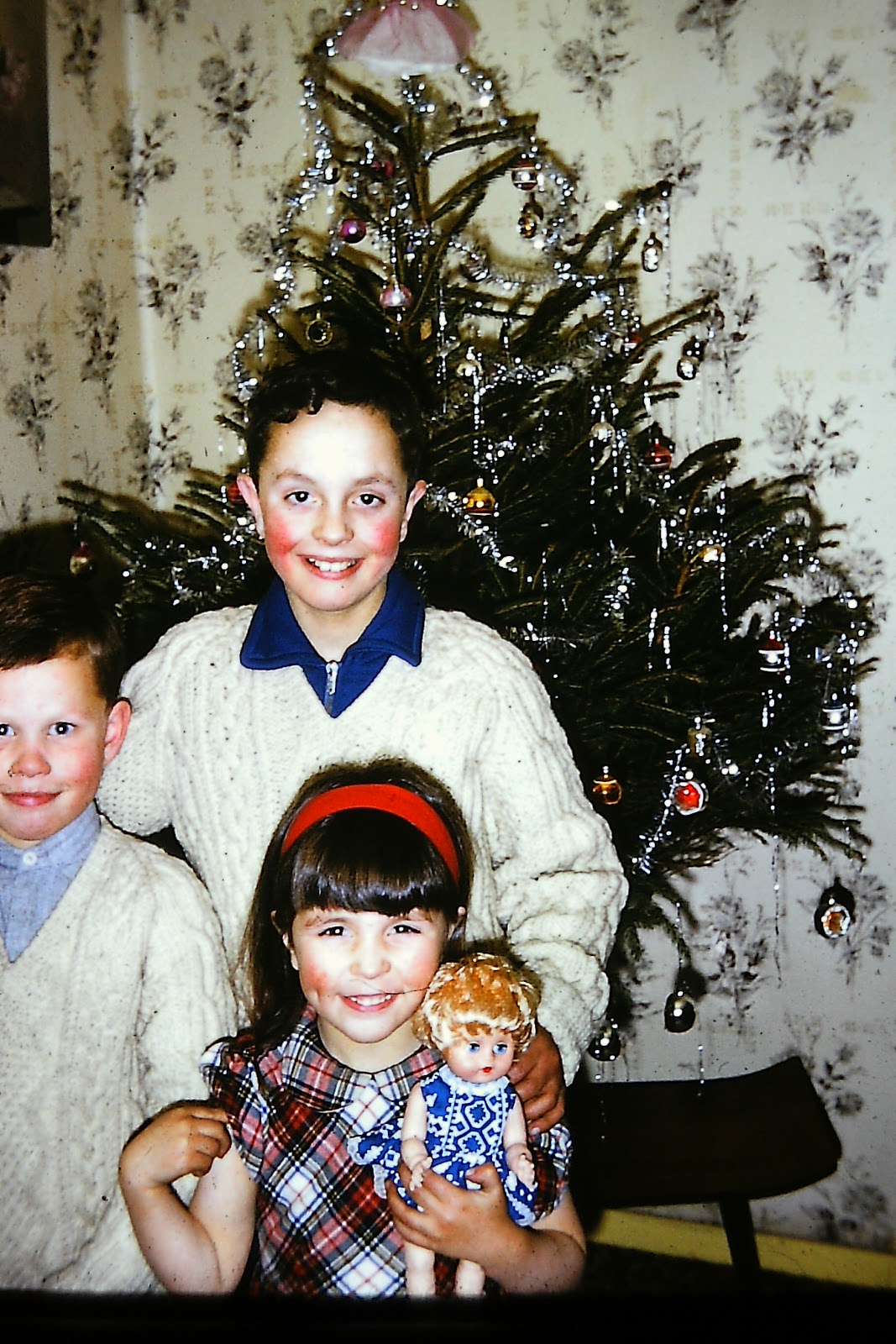
When Anne Hoffmann, Iain Hoffmann and I were young, whatever our circumstances - whether our father was in work or not - Santa Claus always did us proud.

Christmas was always the best and most exciting time of the year.

When I say that Santa (aka Mother, Mrs Anne Hoffmann) - sometimes with support from Father (Ken Hoffmann) did us proud I don't mean that we were spoiled or received any expensive presents - no, instead we always got a stocking which was filled full of imaginative small presents which were an absolute delight to wake up to.


Like most kids it was the one evening of the year when we were keen to go to bed early of our own accord.  And of course it was the one morning in the year that we were keen to get up early too!


I'm not too sure how it worked in all the other households in The Stair.

In terms of quality high spend presents Norman Stewart (6/3 Oxgangs Avenue) did better than any of the other children.

One feature which I didn't enjoy at school was that on our return in January the teacher always asked us all individually, in front of the class, what we had received.

I can recall telling a fib saying that I had been given a graphic designer's set - of course I didn't have a scooby what that was but I was determined not to be out-gunned by Norman - he of course was the one pupil in the class who knew perfectly well that I had not received any such thing!

In my memory Christmas Eve was a very quiet evening in The Stair. 

I can recall my father regularly going out to the Christmas Eve Watchnight church service, presumably at Colinton Mains Parish Church, the same church which the Swansons attended - I don't think he went to the remarkable Reverend Jack Orr's St John's Church service.

Colinton Mains Parish Church


St John's Churdh of Scotland, Oxgangs Road North

Rev Jack Orr
The Hanlons (6/7) always seemed to receive some quite nice presents and they might be seen out playing with them, but not until several days after Christmas Day.

Over the years Mother and our next door neighbour Mrs Molly Swanson (6/1) had an arrangement whereby Mum gave Gavin and Heather a wee tin of Woolworths' toffees and we all received something from Molly - as mentioned I once got a book from her, but when it was opened it instead contained seven tubes of sweets inside arranged horizontally inside.

The Hoggs up above (6/4) always received girly pressies and I can recall my sister Anne spending time with Christina, Maureen and Eileen. I'm much vaguer on the Blades (6/6), other than one year when Alison, Ruth and Esther got their Spacehoppers.

.
Presumably before Anne was born our grandfather gave Iain and me a bobble Santa each which were full of wrapped toffees - the figure is a delight and has been carefully looked after over the past fifty years - each year we bring the two Santas out. The Swansons got a similar Santa figure, but they had less jolly faces.


I may be wrong but I seem to recall that the Hanlons and the Blades were quite big on such decorations as the linked rings which went from corner to corner across the ceiling.


I used to regret that we were more conservative with individual Woolworths' decorations which were very attractive and aesthetically pleasing. There wasn't such a crowded effect which as a boy I would have liked. I suspect Woolworths did Mrs Anne Hoffmann and many other parents proud over the decades.


On Christmas Eve each of the three of would leave one of our mother's nylon stockings at the foot of our beds.

I was always the first of us to awake.

I would crawl down the bed and reach out to see if Santa had arrived yet and then the excitement of feeling the bulkiness of the mis-shapen stocking full of surprises was the most wonderful sensation in the world It's Christmas! I would bellow out It's Christmas! as I jumped down from the bunk bed to switch on the light and awaken the others.


The stockings were just great - they were filled with torches; little games; Yogi Bear or Huckleberry Hound picture books; perhaps a young person's novel; colouring books and pens; a selection box; some gold coins; an orange and an apple and a half crown; The Broons or Oor Wullie annual in later years.

Photograph courtesy Heather Lawrence

Anne would get some girly stuff - I particularly recall a delightful peach smelling cream; whilst Iain might get a toy car, perhaps a Corgi or some Matchbox cars; on one occasion when quite young I got a leather football and football boots. Iain was very into his cars whilst I was uninterested in cars, although ironically I have had more sports cars over the years than one could throw a stick at, much to my wife's dismay.


When we were very young, in our innocence we'd then rush through to awaken our parents to show them what Santa had brought us.

These Christmas mornings were simple little affairs, but wonderful - our mother ensured that these were magical occasions every year from being very small children and into our teens; happy times and very, very sweet memories, which I've never forgotten.

Much like Sundays, on Christmas Day we saw very little of what went on in The Stair because our grandfather would collect us at mid-morning and take us down to Portobello for the day, not returning till late at night - but for that you'll all have to be patient children and wait until Christmas Day to hear that story!

Sunday, 16 December 2012

Dr Motley

Perhaps the most remarkable story of all the individuals at Oxgangs during the 1960s was that of Dr Motley.


Perhaps the most remarkable story of all the individuals at Oxgangs during the 1960s was that of Dr Motley. I always thought he looked amazing. As a wee boy, he would have been the first black man that I had seen. I couldn't take my eyes off him. The fact that he was a different colour to me-black to my white; then there were his hands, I noticed too the contrast of his palms which were a much lighter colour. And of course there was his voice-a lovely, deep, rich, American sound; with a sweet cadence, musicality and deep mellifluousness which was something to behold.

I always found him to be a very gentle man-a gentleman-positive and sympathetic to his patients-he struck me as being a very happy person-he laughed a lot. As I grew older I got a sense of how immaculate in appearance he was-he dressed in beautiful suits, shirts and ties-class jewellery, a gold ring and a lovely watch and a handkerchief in his top pocket-he had a real sense of style and must have cut quite an exotic figure in bleak Oxgangs. Although he wasn't tall he was very handsome with a gentle face.

I have spoken regularly about the concept of transactions and relationships. Partly because it was the 1960s; partly because for years it would have been a one man practice; and partly because of the nature of the man, I always felt I had a personal relationship with him. No doubt hundreds of his patients over the decades would have felt the same.

But what a story. Imagine how challenging it must have been for the young Arthur Phillip Motley. He travelled thousands of miles across the Atlantic Ocean when he came to Edinburgh as a student from the Deep South of the United States of America in the late 1920s.

As a black man in Edinburgh at that time, he would have been in a very small minority, both at Edinburgh University and also in the city. I would imagine that over the years and across the decades he must have suffered some prejudice and the vicissitudes of discrimination. When I looked at his gentle countenance I sometimes thought of the slings and arrows and brickbats he probably endured from people-with his manner he probably did what many smart people do-never reacting, never responding-just ignoring such things and getting on with life. Although Mrs Anne Duncan (Hoffmann) made an astute point to me when she said Would it not have been a lot worse back in the States?

Coming to the city to train as a doctor at the university and at the Royal Infirmary in Edinburgh says a very great deal about his character. To go on to form, develop and build up a practice at McAlester Cottage in the fledgling community of Oxgangs in the late 1940s and early 1950s must have been an even greater challenge.

My early memories of McAlester Cottage are of what a lovely house it was-it was white and red and the finest house in the immediate area. The waiting room had a highly polished floor with seating around the perimeter; in the centre of the room were eight high quality, brightly coloured chairs for small children-it was great fun to sit on them. The family would have stayed at the practice too. I don't remember really seeing either his wife Annette or his daughter-also called Annette-they must have kept a very low profile.

When he was building up the practice he must have worked incredibly hard-no doubt he would have been called out at all sorts of times of the day and night. Building up a practice on his own with all the inherent stresses and strains must have been very challenging for him. And yet whenever he saw you he never exhibited any sign of this.

Until now, I never thought about the name of his home and surgery practice-McAlester Cottage-after all it's a good Scots name. However it's now occurred to me that he would have had the house built for himself-after all it's unlikely that such a house would have been built there at the time if it wasn't for a young doctor. I've now realised that the name was a reminder of home!

He was born around 1906 in Texas. The family must have moved after this to McAlester City (the McAlester of McAlester Cottage to remind him of home?), Oklahoma where they resided at 903 E Monroe. Dr Motley was listed as being a resident there along with his father R Frank Motley who was a minister and his mother Ethel Motley. This is taken from the US Census of 1940. However it's interesting to see that five years earlier, 1935, he was listed as living in Edinburgh where he was a medical intern at the Royal Hospital, Edinburgh. Did he move back to Oklahoma when the Second World War started? Or was it because there were no jobs available in Edinburgh? Or was it for family reasons?

However, he must have begun studying in Edinburgh in the late 1920s because in the 1928 Yearbook for Lincoln University, Pennsylvania-the leading black university says the following:

Arthur Motley 1928


A R T H U R  M O T L E Y
"Hoops"
Motley, now living in McAlester, Oklahoma., also comes to us  from Wiley College.  He belongs to The  Firm, to the Varsity  " L "Club,  and to Alpha .  " Hoops " has been among the honour group students since his matriculation. He is a profound philosopher of life and religion; a lover of women, Wiley, and Bull Sessions. A few years and  "Hoops" will be an M.D. from Edinburgh, Scotland.

I'm surmising here, but I think he perhaps chose to study in Edinburgh at that time, because I think it was regarded as being the leading medical school in the world. A medical degree from Edinburgh meant that in theory one could have practiced anywhere in the world, although that said, as a black man, this would undoubtedly have restricted his opportunities. Many people would have had deep reservations about being treated by someone who wasn't white.

He was still in Edinburgh in 1935, where the Census records him as working in Edinburgh at the Royal Hospital, Edinburgh as a medical intern. However, in 1940 he was recorded as being back at the family home in Oklahoma.

Mrs Anne Duncan (Hoffmann) knows he was a ship's doctor during the Second World War, but we're unsure whether it was the US Navy or the British-I assume it was the American. He told her that when the ship was in port in South Africa and the sailors encouraged him to go ashore he said No I'll have to remain on board-when they asked him why he replied that he was frightened I'd be lynched!

The big question is why he came back to Edinburgh to set up a practice. Again, surmising, it is likely that this was because he had met his wife, Annette. She was the daughter of a shopkeeper who sold tobacco and confectionery. The shop was close to his digs and he'd met her there. I would imagine this must have been why he chose to stay in Edinburgh, but Mrs Anne Duncan (Hoffmann) said that he loved Edinburgh-good taste!

When he was developing the practice at Oxgangs he could be seen cycling on his bicycle to visit patients-again what a wonderful sight that must have been. He must have set up shop around the time of the start of the NHS in 1947-up until then patients had to pay for treatment so people always thought twice about visiting the doctor-not to mention that such bills were always in guineas!

Being married to a white woman must have made life challenging socially and professionally, yet Mrs Anne Duncan (Hoffmann) says that he held regular large parties at home and a line of fancy cars could be seen outside. Before McAlester Cottage was built he stayed in one of the Gumley's houses across from The Store. When Dr Shepherd joined the practice he moved in there when Dr Motley moved to McAlester Cottage. In later years he lived at Buckstone.

Dr Shepherd was an excellent doctor-probably superior to Dr Motley. Dr Shepherd delivered my sister Anne Hoffmann at home on 19 September, 1961. In the decade or so prior to this, it must have been challenging for Dr Motley to learn all the skills required to be a general practitioner-being human he  undoubtedly will have made mistakes. On one occasion I had a poisoned big toe-the poison spread up to my knee-I was delirious and believe there was a danger that I could have lost my leg-when Dr Shepherd visited on an emergency call out, he immediately took control and lanced it.

He was very supportive of our family over the years. It was at his practice that I got a message in June 1976 that I'd been picked for the Olympic Team-ironically I was there getting an injury treated.

Peter Hoffmann 1976
He regularly offered to get me a scholarship to Oklahoma University which I never followed up. Two years later when I moved up to 800 metres for a year I would have been ranked number one in the United States, so undoubtedly a good scholarship would have been available, particularly with his connections there. He kept in touch with his old classmates as can be seen below. After being selected for Montreal he arranged a collection for me as a poor student to support my athletics. I was about to go off to Loughborough University (which I gave up after a week-I didn't feel Coe was good enough to train with when I had Jenkins et al!). I received a sizeable cheque, but we think it was Dr Motley who provided the bulk of the money!


As indicated, he kept in regular touch with his Alma Mater, Lincoln University, Pennsylvania, but I suspect also Wiley College-look out for the film The Great Debaters-all about the outstanding debating team which was formed whilst he was there as a student:

DR.ARTHUR P. MOTLEY, a medical practitioner, travelled the long distance from Edinburgh, Scotland, to be present at Commencement and to celebrate his 55th reunion with his classmates.

Mrs Anne Duncan (Hoffmann) doesn't recall ever seeing his daughter, Annette. I thought that I had, but my memory could not be depended upon. Was she black, white or mixed race heritage? Was she sent away to a boarding school and therefore wasn't in Oxgangs very much? She married someone from Scandinavia-possibly Sweden and settled there. She may have been estranged from her father and possibly quite bitter toward him. Towards the end of his life she wrote to him and made an attempt to get back in touch but Dr Motley said that although he intended to leave most everything to her, he felt it was too late in the day and that there had been too much water under the bridge. Mrs Anne Duncan (Hoffmann) thinks that back in the 1980s grandchildren came to visit him and he took them for a tour of Edinburgh on the top deck of the Number 32 bus which had a circular route.

Whenever I think of Dr Motley it is with great fondness-the mention of his name brings a smile to my face. He was kind,gentle and a caring doctor-he had an appetite for life and you felt better for spending a few minutes in his happy company.What a remarkable man and extraordinary character he was.


Wednesday, 26 September 2012

Harvest Festival

Was it the poorest giving to the poor?

'The Harvest Moon', Peter Hoffmann, 2008
At this time of the seasonal year in the 1960s sometimes tying in with the Harvest Moon the annual Harvest Festival was held at Hunters Tryst Primary School.

Local schoolchildren were expected to bring in small items of food - some fruit, vegetables or a tin.

The contributions were then laid out artistically on tables in the school hall making for a wonderfully colourful display.

There would also be a special Harvest Service held in the school hall conducted by the Reverend Jack Orr from the local parish church.


Because of its religious connotation, I don't suppose these Harvest Festivals are still held in many schools, but I suspect they're actually more grounded in pagan tradition. Certainly the word haerfest is the old English word for autumn.

I enjoyed the occasion - they always had a particularly happy, optimistic feel to them reflecting the celebration of autumn and the bringing in of a good harvest; it was an interlude before winter set in and it was another of the rather comforting milestones in the calendar year which are important to children.

The food was thereafter distributed to local pensioners, but I wonder if they were not less in need of the largesse than many local young families in Oxgangs?