Comments

'And finally, not everyone’s being doing topical. In fact, here’s the rather lovely 6 Oxgangs Avenue devoted to the history of the development of the area, this week highlighting how the block of flats came into being. Could have been prompted by Who do you think you are? Or just a timely reminder that not everything worth blogging about is in the here and now.'

Kate Higgins, Scottish Roundup 26/08/2012


Showing posts with label Halloween. Show all posts

Thursday, 31 October 2019

Halloween - it's Better to Light a Candle than to Curse the Darkness


Photograph William Warby

Back in the 1960s, moving toward Halloween, we used to take ‘neeps’ from the local farmers' fields at Dreghorn, Hunters Tryst and Swanston to be carved out as lanterns. Stealing from the farmer could be challenging - to escape from him might involve a long run along an open road such as from the former Polo Fields and if he was on his tractor, well the turnips would be too cumbersome and heavy to hold on to as they slowed you down, so we would hide them in a ditch to collect them later.
Making lanterns from these root vegetables was the main way that Halloween was marked at ‘The Stair’. I can recall Boo-Boo Hanlon (6/7 Oxgangs Avenue) and Iain Hoffmann sitting (6/2) atop the back shed roof toiling over their lanterns: making the lanterns was hard going because the neeps were often rock hard in the centre unlike the more fleshy pumpkins that have become so prominent in the shops over the past twenty years.
Another thing in favour of pumpkins is they don't give off the same pungent smell that emanates from neep lanterns and candles.
Guising became much more prominent in Oxgangs during the latter part of the 1960s and I can recall some of the kids from the Stair and their pals from numbers 2, 4 and 8 Oxgangs Avenue going door to door, where they picked up a few bob. However, their costumes were nothing compared to today; occasionally some of the kids were imaginatively dressed up, particularly with some make up, but I'm afraid the standard fare was a bed-sheet and a tea-towel on your head, to pass yourself off as an Egyptian!
But we had masks too which offered some creative potential to work with. In the very early days the masks were made of a paper come cardboard material akin to an egg box, but the drawback was that with wear and tear they swiftly became detached from the elastic band: but as the decade progressed, plastic masks became more popular, eventually replacing them.
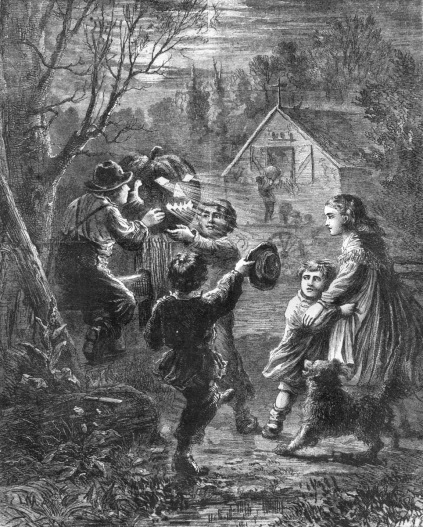

Halloween has a long and fascinating tradition - a mix of All Hallows Eve; a celebration of the end of the harvest; the passing of summer into winter and so on. Lanterns were important - they were left on gate-posts, in windows or door-ways, to guide folk back home from the fairs and festivities; then there was Jack'O'Lantern in Somerset with allusions to the flickering lights in the marshes signifying the souls of unbaptised children.


I'm glad that at Oxgangs we followed in the long tradition of lanterns - there's something very special about providing a light in the darkness and I very much subscribe to the philosophy that it's better to light a candle than to curse the darkness.


Wednesday, 31 October 2012

Halloween - Providing a Light in the Darkness

In the general cycle of the Oxgangs year, whilst New Year; Burns Day; Easter; Church Fêtes  the School Summer Holidays; Elections; the Harvest Festival; Victoria Day and Guy Fawkes bonfires; and of course Christmas were all marked and celebrated significantly in their own way, Halloween was perhaps slightly lower key at The Stair during the decade of the 1960s.

Halloween masks were quite common, but they were the old fashioned cardboard types - plastic masks grew in popularity in later years - possibly this was because the band which you pulled around your head eventually tore the cardboard type apart making the mask redundant.

However, there was a definite move from the beginning of the 1960s toward something which was much more significant and by the latter part of the decade it was an integral part of the Oxgangs seasonal calendar.

In America, Trick or Treat, has been a significant tradition in the year from the 1930s; the UK has probably followed suit, like in many other areas of life, although, a bit like Bob Dylan and traditional folk songs, it all becomes inter-woven over the generations, with cross fertilisation.


In an earlier blog, Neep, Neeps and Apples I made mention of stealing turnips or suedes from the local farmers' fields at Hunters Tryst; Dreghorn and Swanston.

The neeps were stolen toward the end of October and Halloween to be carved out as lanterns. Stealing from the farmer could be challenging - to escape from him might involve a long run along an open road such as toward the Polo Fields and if he was on his tractor, well the turnips would be too cumbersome and heavy to hold on to as they slowed you down, so we would hide them in a ditch to collect them later.

Making lanterns from these root vegetables was the main way that Halloween was marked at The Stair; I can recall BooBoo Hanlon and Iain Hoffmann sitting atop the shed roof toiling over their lanterns - making the lanterns was hard going because the neeps were particularly tough - rock hard in the centre, unlike the more fleshy pumpkins that have become so prominent in the shops over the past twenty years - again something which we've taken from America; although they got the idea for lanterns from Scots and Irish immigrants.


Another thing in favour of pumpkins is they don't give off the same pungent smell that emanates from neep lanterns and candles!

d'Artagnan assisting his Mum!
Living in a quiet small hamlet in the Highlands, but where there are over twenty children, has meant that it has always been a major event here; indeed d'Artagnan is a dab hand at assisting his mum to make the lanterns which stand menacingly outside our kitchen door to welcome and scare the 'guisers' in equal measure.

Guising became much more prominent in the latter part of the 1960s - it was never something that I indulged in, but certainly I can recall some of the kids from The Stair and also their pals from numbers 2, 4 and 8 Oxgangs Avenue going door to door, where they picked up a few bob.

However, their costumes were nothing compared to today; occasionally some of the kids were imaginatively dressed up, particularly with some make up, but I'm afraid the standard fare was a bed-sheet and a tea-towel on the head, to pass themselves off as an Egyptian!


Halloween has a long and fascinating tradition - a mix of All Hallows Eve; a celebration of the end of the harvest; the passing of summer into winter and so on. Lanterns were important - they were left on gate-posts, in windows or door-ways, to guide folk back from the fairs and festivities; then there was Jack'O'Lantern in Somerset with allusions to the flickering lights in the marshes signifying the souls of unbaptised children


Looking back, if you'll excuse the pun, I clearly missed a trick - indeed this blog could just as easily have featured under the series (Not) Being Entrepreneurial!


But looking back, though for much of the decade it was slightly lower key, I'm glad that we followed in the long tradition of lanterns - there's something very special about providing a light in the darkness and I very much subscribe to the philosophy that it's better to light a candle than to curse the darkness.


Saturday, 1 September 2012

NEEEEP!, Neeps and Apples


Today's the start of autumn'...season of mist and mellow fruitfulness'-and I'm in Edinburgh-hurrah!

As August turned to September and then drifted in to October the daylight available to play started to diminish, but there were still enough hours for adventure immediately after school finished. Some of the fun to be had revolved around neeps and apples. Fun for Douglas Blades, as he whisked downstairs, was bellowing out a long drawn out NEEEEP!-he did this for years-it was his trademark soundtrack and was actually quite original, I liked it, although it was less popular with the adults, especially very early in the morning!

Not many of these fruit and vegetables were grown in Oxgangs, so half the fun was that a group of us would have to venture out of the area-for apples it was mainly to Greenbank or occasionally Colinton; for turnips or neeps we would venture to the farmers’ fields up at Swanston and Dreghorn. 

These trips always gave us a buzz because strictly speaking we were stealing; there was a high degree of risk- possibly even getting caught. Because of the nature of the theft-somehow it didn’t feel like theft in the normal sense of the word-I suspect this was because of tradition and partly because of the nature of the items involved (So much for tradition-I've just discovered that in Victorian times the sentence was a month of hard labour for stealing turnips!). 

Painting by Karl Witkowski
We weren't after these items because we were starving or desperate to have a piece of fruit. We often didn't eat the apples and sometimes they were sour. The fun was in the act. The fun was in going out in a group, searching out particular gardens where trees were heaving with apples-usually located in people’s back gardens-and then there was the daring involved in clambering into these gardens usually over fences or through gates and then stealing the apples. On many occasions we would be spotted by the owners and it gave us an enormous buzz when we would all have to take to our heels and run like the wind. After we had reached safety we breathlessly exclaimed our relief and laughter at our narrow escape as we headed for home, although there was always still a small risk that the police might yet appear.


The neeps were stolen toward the end of October and Halloween-they were to be carved out as lanterns. Stealing from the farmer was more challenging-to escape from him might involve a long run along an open road and he might have access to a tractor-the turnips would be too heavy to hold on to as they slowed one down-if we had the time we would hide them in a ditch to be collected later.