Comments

'And finally, not everyone’s being doing topical. In fact, here’s the rather lovely 6 Oxgangs Avenue devoted to the history of the development of the area, this week highlighting how the block of flats came into being. Could have been prompted by Who do you think you are? Or just a timely reminder that not everything worth blogging about is in the here and now.'

Kate Higgins, Scottish Roundup 26/08/2012


Friday, 6 March 2020

Spring 1971 An Edinburgh Adventure

On Saturday, 6 March, 1971 five of us took off on a spring adventure - Ali Douglas; Les Ramage; Boo-Boo Hanlon; Iain and Peter Hoffmann..

  Ali Douglas; Iain Hoffmann; the Authorand ‘Boo-Boo Hanlon in front of
Mons Meg, Edinburgh Castle, 1971
      
We took the number 27 bus to Edinburgh Castle to explore our heritage. It was always good fun going out together, great company with many laughs. Although we had a rough outline of the day ahead, we never quite knew what would happen or who we might meet along the way.
                   

Iain Hoffmann; the Author; and Boo-Boo Hanlon - Soldier unknown


Iain Hoffmann; Boo-Boo Hanlon; and the Author 43 years later at
Swanston Golf Club, Edinburgh

From the castle we walked all the way down the Royal Mile and then up and over Arthur's Seat. We were in no hurry and walked at an easy pace, calling in at one or two of the shops along the way. There were fewer tourists around then and the Old Town still had a significant population, so it was local people and workers who were in the area.
                

Iain Hoffmann and Ali Douglas Boo-Boo Hanlon and Les Ramage Arthurs Sea

Although we were young and fit the climb up Arthur's Seat was a stiff one and we quickly built up a sweat and the beginning of a sound appetite. At one stage, whilst running through the long grass, we unknowingly came to the edge of a sharp precipice which would have been all too easy to have fallen over.


 Ali Douglas and either Les Ramage or  Boo-Boo dangerously close to the edge above Holyrood Palace

We had a general sense of direction now. Once we had reached the summit and taken in the 360 degree panoramic view of Edinburgh, we traversed Arthur's Seat and got sight of Duddingston Loch in the valley below; we'd found our bearings. It was downhill now. We leapt like hares and galloped like horses, occasionally crashing, rolling and laughing, as we ran and tumbled down the hill.


No matter the weather, Holyrood Park and Duddingston Loch are quite magical with quiet  parts where you can completely escape the city.
                    
Duddingston Loch, Charles Lee, 1853


A century before, Robert Louis Stevenson enjoyed it in all the seasons too. He writes in the winter of 1874, of looking down on the frozen loch, at the skaters flitting around, under the light from the moon and lit torches.
                    

Skaters, Duddingston Loch, Charles Lee, 1857

A fantasy in dull school lessons was to visit Duddingston Loch on a spring or autumn Saturday afternoon with a rubber dinghy and gently float around the loch, whilst listening to a football commentary on my miniature radio.             

Duddingston Loch

After the excitement of Edinburgh Castle, the Royal Mile and Arthur's Seat, the long road through Duddingston to Durham Road was the least enjoyable part of the journey, particularly because by then, we were hungry.

 Boo-Boo Hanlon, Duddingston Golf Course, 1971 the end in sight

Afternoon tea awaits for five hungry boys

We hadn't planned ahead or notified our grandparents, but we knew from old, that there was no trouble turning up announced on their doorstep. There was a warm welcome and a massive tea soon followed bacon and eggs and scones and buns were soon drummed up for us to enjoy.
  
Grandfather (Gaga), buying the Ford Zephyr, Hawick with the Author


After tea, we got a lift back home from Portobello to Oxgangs in our grandfather's large stylish Ford Zephyr car with its American styled tail fins. It easily accommodated three in the front and three in the back. I suppose we were cheeky in requesting a lift back by 6.30 pm, but Ali had to get home to see an Aunt and Uncle. Even after the day’s adventures, we still had the energy to play a game of singles and dodgy ball well into the evening.

Happy, timeless and seemingly endless days of friendship and companionship.

Thursday, 31 October 2019

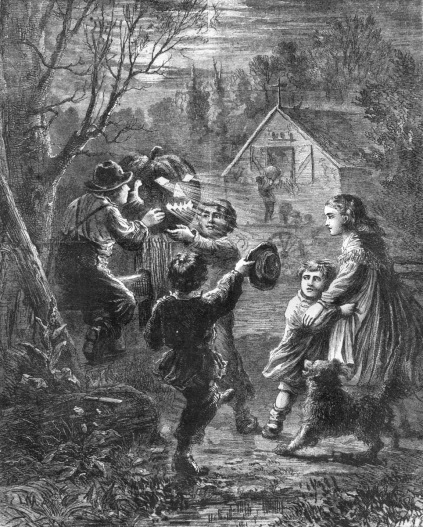
Halloween - it's Better to Light a Candle than to Curse the Darkness


Photograph William Warby

Back in the 1960s, moving toward Halloween, we used to take ‘neeps’ from the local farmers' fields at Dreghorn, Hunters Tryst and Swanston to be carved out as lanterns. Stealing from the farmer could be challenging - to escape from him might involve a long run along an open road such as from the former Polo Fields and if he was on his tractor, well the turnips would be too cumbersome and heavy to hold on to as they slowed you down, so we would hide them in a ditch to collect them later.
Making lanterns from these root vegetables was the main way that Halloween was marked at ‘The Stair’. I can recall Boo-Boo Hanlon (6/7 Oxgangs Avenue) and Iain Hoffmann sitting (6/2) atop the back shed roof toiling over their lanterns: making the lanterns was hard going because the neeps were often rock hard in the centre unlike the more fleshy pumpkins that have become so prominent in the shops over the past twenty years.
Another thing in favour of pumpkins is they don't give off the same pungent smell that emanates from neep lanterns and candles.
Guising became much more prominent in Oxgangs during the latter part of the 1960s and I can recall some of the kids from the Stair and their pals from numbers 2, 4 and 8 Oxgangs Avenue going door to door, where they picked up a few bob. However, their costumes were nothing compared to today; occasionally some of the kids were imaginatively dressed up, particularly with some make up, but I'm afraid the standard fare was a bed-sheet and a tea-towel on your head, to pass yourself off as an Egyptian!
But we had masks too which offered some creative potential to work with. In the very early days the masks were made of a paper come cardboard material akin to an egg box, but the drawback was that with wear and tear they swiftly became detached from the elastic band: but as the decade progressed, plastic masks became more popular, eventually replacing them.


Halloween has a long and fascinating tradition - a mix of All Hallows Eve; a celebration of the end of the harvest; the passing of summer into winter and so on. Lanterns were important - they were left on gate-posts, in windows or door-ways, to guide folk back home from the fairs and festivities; then there was Jack'O'Lantern in Somerset with allusions to the flickering lights in the marshes signifying the souls of unbaptised children.


I'm glad that at Oxgangs we followed in the long tradition of lanterns - there's something very special about providing a light in the darkness and I very much subscribe to the philosophy that it's better to light a candle than to curse the darkness.


Monday, 21 October 2019

Fallen But Not Forgotten - the Number 16 Bus '655' Accident


A small update on Robert Law's remembrance of the fallen Number 16 bus.


The 16 bus that toppled over on the 18th June 1975 was a Leyand PD3 with Alexander body and registered ASC 655B. Here’s a photo of the bus that came a cropper at Oxgangs on Wednesday 18th June 1975; it appeared on the front cover of Buses Magazine; the bus was subsequently scrapped.

The Edinburgh Evening News for the day said nine were hurt in the accident - a lorry hit the bus as it turned right from Oxgangs Road North and into Oxgangs Avenue. Interestingly it wasn't actually the accident which resulted in '655' being scrapped. The crane sent out to get the bus managed to distort its offside doing so and that was enough to put '655' off the road for good.


The inimitable Douglas Blades (6/6 Oxgangs Avenue) comments: 'Our father, Charles Blades, was shaving at the side window in the large bedroom and that window looked out towards the junction. I wasn't in at the time but the story was related later. He exclaimed to our mother, ‘Helen, that bus is toppling over – or words to that effect!'

The Boy With A Green Pistol and the Felled Number 16 Bus!

Hello Mr Hoffmann,

I hope this email finds you well. 

I saw your article a few years ago about an Oxgangs bus incident and was going to contact you, but just never got round to it. I hope I don't annoy you by going over this story. 

On a short break from Dumfries to the Jurys Inn in Edinburgh next to Waverley Station back in November 2014, my future wife and I had been doing a bit of sight seeing and had taken a few good photos up at Calton hill and the Folly. We had worked up a good appetite and were now getting ready for evening dinner. While Judith was having a shower I happened to look out the window onto an arch bridge on Waterloo Place; when you see it at night it's well lit underneath with colourful lights and you could see the vehicles on top travelling to and from Princes Street.

I recollected travelling up from Dumfries visiting my Nana Law at Oxgangs back in the 70s. (It would have been on the 18th June 1975 - Peter Hoffmann). I remembered clearly when I was about 4 years old walking with my dad down, I think I am right in saying 'Colly Mains Road' as they call it (Colinton Mains) and past R. Drummond the Chemist to a toy shop where my dad bought me a bright green water pistol. 

We walked back to my Nana's (Nana Law also known as Angie Law) the long way and instead of going in at the bottom of the hill at the chip shop and Scotmid end we walked further up where we saw a toppled double-decker bus that had taken down a fence at the side of a church. My dad and I went to my Nana's house and picked up his camera and went back round the corner where he took a photo that he would keep in his wallet for the rest of his life, a picture of me grinning, holding a bright green water pistol beside a bus on its side that had some recovery men at it.

'Honestly officer, I didn't shoot the number 16 bus down!'
Robert Law aged 4 in front of the toppled 16 bus

I had an early fascination with anything mechanical especially buses, I grew up to take an apprenticeship mechanic job with Western Scottish buses in Dumfries in 1987 and spent nearly 17 years there. It must have been in my blood. My papa from Edinburgh was a precision Engineer for the water board and one of his sons Alistair Law who had also stayed nearby my nana in Oxgangs in one of the flats worked as a lorry driver for Texaco. 

I decided to go onto the internet and see if there was any information on the toppled bus hoping that I might find something about it. I came across your blog "The Stair" that seemed interesting to me as it was about Oxgangs, a place that held a lot of memories from my childhood. 

I read on further and it mentioned someone looking out from across the road witnessing a bus starting to topple, I searched further and it took me to the picture of Ian Allan's "Buses Illustrated" magazine issue number 177 December 1964  2/6, and with a shiver down my spine read that this was the toppled bus. It was photographed brand new on its first day in service  sitting at the bus stop facing Princes Street, on the bridge on Waterloo Place, just as I was looking at the bridge. 

To make things more special for me and my memories about my dad twho came from Edinburgh and subsequently passed away in 2006 with a picture of a wee boy holding a bright green water pistol beside a double-decker bus on its side in his wallet,  

I went onto Amazon and found as advertised in excellent condition from a collector a single copy of Ian Allan's "Buses Illustrated" magazine, issue number 177 from December 1964 priced at 2/6 showing the bus on the bridge that I was looking at from my window of a hotel bedroom window, and proudly have it to this day along with my dad's old wallet.

Thanks for having the article on the internet for me to find. 

Robert Law.


Tuesday, 3 September 2019

Follow That Dream - The Oxgangs Broadway Pioneers

'Mary (Ball) at the Broadway'

When you are young you accept the world as it is. And that it must always have been thus.

From a young age I used to go up the hill (Oxgangs Street) regularly to the (Oxgangs) BroadwayInitially, I would be sent for messages and when older it would also be of my own volition too. Probably this was from the age of only three or four.   

Britain was famously called a nation of shopkeepers and even today it remains a dream occupation for many people.

Growing up in the area I never really considered that the shops at Oxgangs Broadway had not always existed, whereas they would have been built around the mid 1950s.

And of course behind each and every business venture there was an individual and a human story - a tale of individuals seeking out an entrepreneurial opportunity and actively taking the risk of following your dream - a dream of making it economically - a dream of working for yourself and aiming to provide for your family to lead a good and satisfying life.

Ian Ewart

And whilst the motivation might be economic it may just as easily be because you didn't have a skill or a profession or that you simply just didn't like working for someone else.

A collection of the individual stories of those early pioneers from over sixty years ago - the first shopkeepers at Oxgangs Broadway would make for interesting reading today - their hopes and their aspirations; their successes and their failures; the ups and the downs; the joys and the worries; and the colourful customers; colourful stories and the life lessons learnt.

Was it a success or was it a failure?

Did it provide a good income or was it always a struggle?

How did it affect their health? And what happened if they were ill?

Was the business seasonal?

How above board was it!

Were there unusual or unorthodox transactions and business arrangements!

Did the stock fall off the back of a lorry!

Did some customers get 'tick?'

Did the early aspiration meet the realisation?

Did it become a conveyor belt that you just couldn't get off?

And if they could go back in time would they have done it all again?

All those stories, now sadly gone and difficult to resurrect.

As a young customer I only saw the shops as being retail institutions - they were there for our convenience and being too young was too unperceptive to realise there was a human story behind each and every one.

I assume that when the public housing schemes were first muted, designed and developed after the war that Edinburgh Corporation must have taken cognisance of local needs and included these small retail shop units for rental. But did they deploy a prescriptive and restrictive policy whereby (forgive the pun!) they had a 'shopping list' of the range of businesses they wanted to include e.g. one post office; one chemist; a dry-salter and so on or was it just left to the market and a laissez-faire approach?

'Forgan the Chemist' Photograph Sandra Catterson

Probably for most of the individuals it would have been their first venture as self employed businessmen - it was mainly men that owned the business although I recall the shoe shop seemed to be owned by a lady.

I suspect that for some of those entrepreneurs they had perhaps worked in the particular trade but never before been the owner of the business. Now here was a once in a lifetime opportunity to go it alone - what excitement - what a worry! But how satisfying too.

Similar to tenants becoming home owners under Mrs Thatcher's government I wonder if in later years and decades they thereafter had the opportunity to purchase the shop units? I expect so. And that by then the shops that came and went in more recent decades were very much dictated by the market economy.

The shops at Oxgangs Crescent (sadly, now demolished) were similar to those at Oxgangs Broadway, except there were fewer of them whereas the shops at Oxgangs Broadway remain today, but are of course different; however there are still some similar types of shops to the past - e.g. a newsagent - but also there's a betting shop and three hairdressers; there is a convenience store - family owned and long established which has picked up some awards but is now up against the recent Aldi development on the former St John's Church site.


Photograph Mark Travis

The Oxgangs Broadway design is a rather dinky and clever lay out which when seen from above is shaped like a cockit hat - an interesting triangular shape with a road bordering the three sides - similar to the Cockit Hat at the Redford Road/Oxgangs Road North junction. 

On the north side there are some flats (recently refurbished) located above the shops which unusually take up two floors i.e. levels two and three. 


Photograph Scott Arthur

The flats are most handily located if you run out of bread, milk or sugar or want to nip out for an early morning roll or newspaper but perhaps with an adjacent chip shop or betting shop, too temptingly close too!

The shops are set below ground level in a small self-contained dip of ground and mostly evenly distributed and laid out opposite each other; in winter the snow perhaps lies longer there. But the area between the shops serves as an interesting social area where during the day local neighbours can catch up with one another’s news. 


Oxgangs Broadway In The Winter

Back in the 1960s the shops were fairly small. However, there was a general St Cuthbert's Store  - the Co-op - which was larger than the others and Ewart's took over the adjoining number 1 unit to create a double shop unit.


Behind the shops and up above were some further units including the well known Risi's Fish and Chip shop and Ben Mackenzie's Hairdresser's shop on on each opposite corner, but I seem to recall these units were mainly used by the shop-keepers down below for storage or back shop operations e.g. the butcher?


Photograph Mr Craigie

Today, these units are all in use including a large Corals bookies. It's unsurprising because these shop units are south facing and you can park directly outside; however they are set away from the 'main body of the kirk.'

In 1836 Charles Dickens lamented that newer, shinier establishments are replacing ‘quiet, dusty old shops’. Some of Joseph Mckenzie's recent memories of 'Jock the Butcher' who worked at St Cuthbert's Co-op at Oxgangs Road North makes me optimistic that with the fantastic resource of the 'Oxgangs - A Pastime From Time Past' Facebook group and 'online encyclopedia' that we may yet still rescue some of the tales and stories of the original shop-keepers at 'The Broadway' before it's too late in the day.

Listed below are each of 'the originals.'

1. Macnab A & J Ltd.
2. Ewart, Mrs E.
3. McNish, R.F.
5. Holmes
6. McKenzie
7. Forgan D.R.
8. Smith, C.
11-14 Smith, W.
9&18 Sandison & Douglas
St Cuthbert's Co-operative
12. Allan G.
Risi
Ben Mackenzie